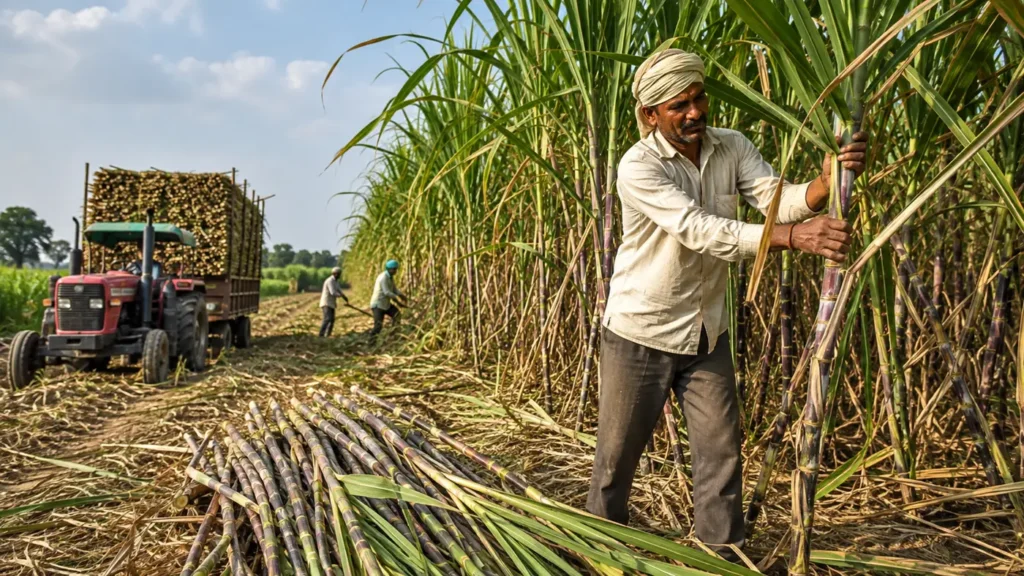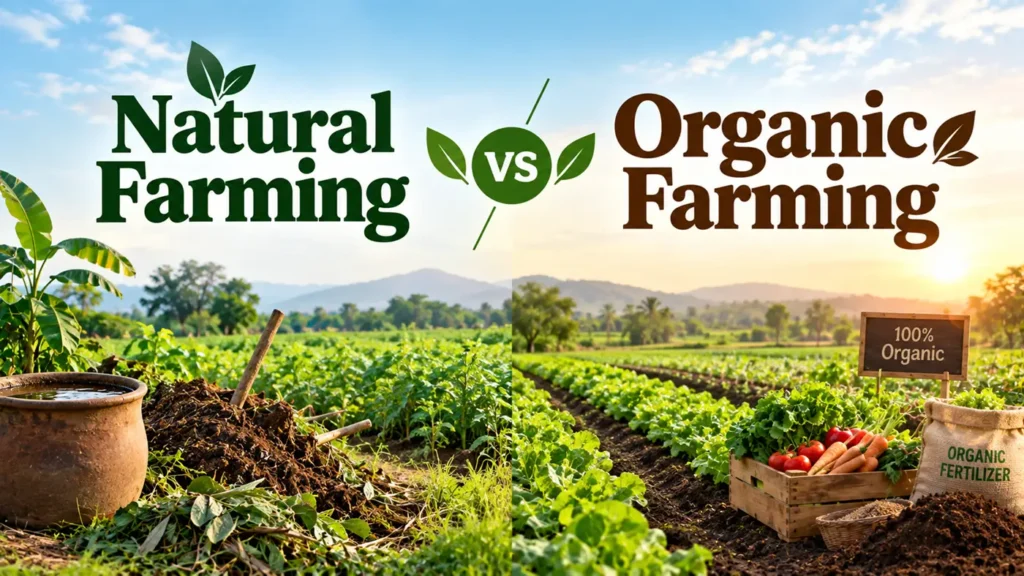
Agriculture has over time moved towards farming methods which stress soil health, environmental sustainability, and a decrease in reliance on synthetic agricultural inputs. The two approaches that are frequently referred to in this area are natural farming and organic farming. While both seek to promote more sustainable agricultural systems, they differ in their principles, the inputs they use, the certification requirements and the ways in which crops are managed.
Understanding the difference between natural farming and organic farming is important for farmers, consumers and anyone interested in sustainable agriculture.
What is Natural Farming?
Natural farming is an approach that aims to work with natural ecological processes and minimize external agricultural inputs. It places considerable emphasis on maintaining soil health, encouraging beneficial microorganisms and using locally available or farm-derived resources.
Natural farming systems may use materials such as crop residues, biomass, animal-based preparations and botanical extracts. The exact practices can vary depending on the region and farming system. In India, Zero Budget Natural Farming (ZBNF), later commonly referred to as Natural Farming, has received considerable attention as a farming approach that seeks to reduce farmers’ dependence on purchased inputs.
The underlying idea is to encourage the farm ecosystem to function with minimal outside intervention while maintaining agricultural productivity.
What is Organic Farming?
Organic farming is a regulated agricultural production system that generally avoids the use of synthetic fertilizers and pesticides and relies on practices such as crop rotation, composting, green manure, biological pest management, and other ecological methods.
Organic farming may include the use of inputs which are obtained from outside sources, on the condition that such inputs comply with the organic standards in question. For instance, organic farmers can make use of organic fertilisers that are approved or biological pest-control products.
Organic agriculture can also involve certification, which verifies that production follows specified organic standards. These standards differ between countries and certification systems.
Natural Farming vs Organic Farming
| Aspect | NATURAL FARMING | ORGANIC FARMING |
| Approach | Works with natural ecological processes and aims to minimize external inputs. | Uses approved organic practices and inputs according to defined standards. |
| External Inputs | Generally seeks to minimize purchased inputs. | Permitted inputs may be purchased if they comply with applicable standards. |
| Farm-made Preparations | Often given significant importance. | Maybe used, depending upon the production system and standards. |
| Synthetic Chemicals | Generally avoided. | Generally prohibited under organic standards with specific rules and exceptions. |
| Certifications | Certification requirements depend on the particular program or market. | Formal certification may be required to sell products as certified organic. |
| Soil Management | Focuses strongly on biological activity and natural soil processes. | Relies on compost, manure, crop rotation, green manure, and other approved practices. |
| Cost Structure | Attempts to reduce dependence on purchased agricultural inputs. | Can involve additional costs for approved inputs and certification. |
Difference in Use of Agricultural Inputs
One of the most important differences lies in how the two systems approach inputs. Natural farming generally attempts to make greater use of resources already available within or around the farm. Farmers may prepare certain biological or botanical formulations themselves rather than purchasing commercial products.
Organic farming, on the other hand, does not necessarily mean that everything must be produced on the farm. Certified organic farmers can use inputs permitted under the applicable organic standards. Therefore, organic farming is not simply farming without any external inputs.
Soil Health and Biodiversity
Both approaches place importance on maintaining healthy soils and supporting biodiversity. Natural farming places particular emphasis on encouraging biological activity in the soil and allowing natural ecological processes to play a greater role.
Organic farming usually chooses methods like composting, crop rotation, cover crops, green manure, and biological pest control. When these practices are properly managed, they can further help to improve soil fertility and biodiversity.
However, neither system guarantees the same outcomes on every farm. Results can depend on climate, soil conditions, crops, management practices and access to resources.
Certifications and Standards
Another major distinction is certification.
Organic agriculture is supported by established production standards in many countries. Farmers who want to market their produce as certified organic generally have to follow specific requirements and, where applicable, undergo inspection and certification.
Natural farming does not have one universally applicable global certification system equivalent to organic certification. Different government programs and organizations may have their own standards, verification systems, or guidelines.
This distinction becomes particularly important when consumers see labels such as “organic” or “natural” on agricultural products.
Which Crops Can Use These Methods?
Both natural and organic farming can be applied to a wide range of crops, including cereals, pulses, vegetables, fruits, spices and plantation crops. However, the suitability of a particular practice depends on local soil conditions, climate, crop requirements, pest pressure and the farmer’s resources.
Farmers therefore need to evaluate individual techniques rather than assuming that one method will work identically everywhere.
Benefits and Challenges
Natural farming may help farmers reduce their dependence on purchased inputs and encourage the use of locally available resources. However, farmers may need time, knowledge and suitable local resources to successfully implement the approach. Yields can also vary depending on the crop and farming conditions.
Organic farming can support soil management, biodiversity and reduced reliance on synthetic agricultural chemicals. At the same time, certification requirements, labor needs, input availability and possible yield changes during the transition period can create challenges for farmers.
It should not be regarded as a simple all-round substitute for all traditional farming methods, since successful implementation depends on proper management and taking into account the local agricultural conditions.
FAQs about Natural Farming vs Organic Farming
Natural farming and organic farming have among their objectives the improvement of soil health, the support of ecological processes and a reduction in the dependence on synthetic agricultural inputs. Yet the two systems are not the same.
In natural farming there is a greater focus on reducing the use of external inputs and on making use of natural and farm-based processes, whereas organic farming works under specific standards which determine which agricultural practices and inputs may be used.
If farmers understand these differences they will be in a position to make informed decisions and consumers will then be better able to grasp the meaning of various agricultural production systems. In the end, the success of either method will depend on how well it is suited to the local environment, the crops involved, and the farming conditions.