Agriculture has for a long time been based on knowledge, the right timing and careful observation. Instead of following any general rule, farmers have in the past depended on their experience in order to know when to sow their seeds, to irrigate their crops, to apply fertilisers or to protect their plants from pests. The situation is now changing, since farming is becoming more and more data-driven. Artificial Intelligence (AI) is nowadays assisting farmers in analysing large quantities of information and enabling them to make quicker and more informed decisions regarding their crops and their resources.
By combining a variety of technologies, including machine learning, computer vision, predictive analytics, remote sensing, and robotics. AI is able to tackle some of the most significant challenges facing modern agriculture. Such challenges involve unpredictable weather conditions, scarcity of water, outbreaks of pests and diseases, degradation of the soil, increasing costs of inputs, and the requirement to produce more food in a sustainable way. Recent agricultural research has identified a range of applications, such as yield prediction and soil mapping, as well as precision irrigation, detection of crop diseases, and assessment of food quality.
The technology is likewise becoming more relevant in India; in 2026 the Indian Council of Agricultural Research (ICAR) identified AI-enabled agricultural extension, real-time crop advisories, pest surveillance, weather-based recommendations and market intelligence as emerging tools for supporting farmers.
What Does AI Mean In The Context Of Agriculture?
Using artificial intelligence in agriculture involves collecting, processing, and interpreting agricultural data in order to aid farming decisions. AI systems are able to analyse information from sources such as:
- Soil sensors
- Drones and cameras
- Farm machinery
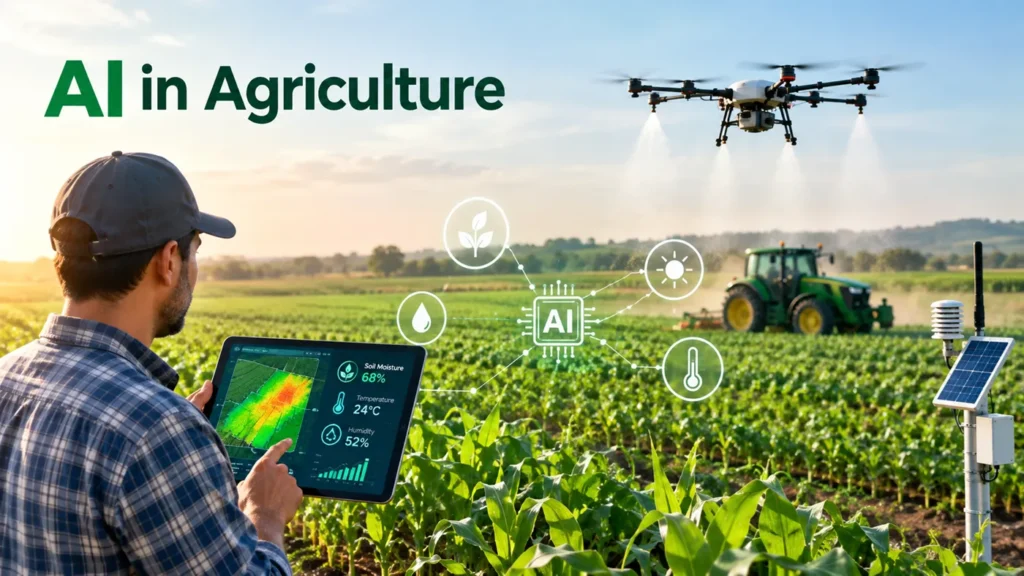
Instead of treating the entire farm as one area, AI can identify differences in soil moisture, crop health, nutrient needs, and pest activity. As a result, farmers can make more targeted decisions based on the actual conditions in their fields.
In simple terms, AI helps agriculture shift from reacting to problems to predicting and preventing them.
How is AI Used in Agriculture?
AI usually operates by examining large datasets and detecting patterns which are not obvious to people. For instance, machine-learning models can be trained using historical data on weather, soil, crops and yields in order to make predictions regarding future crop performance.
The sensors might detect a decrease in soil moisture. The AI system could then combine this information with the weather forecasts and the crops’ requirements in order to determine whether or not irrigation is needed. Instead of automatically watering the entire field, a smart system could instead recommend or start irrigation only in the areas where it is required.
AI, sensors, satellite data, and connected farm equipment together play a big role in precision agriculture.
The Types of AI Usages in Agriculture
Machine Learning
Machine learning allows computer systems to detect patterns in agricultural data and enhance their predictions as time goes on. It can be used for:
- Crop yield prediction
- Weather and climate analysis
- Pest and disease forecasting
- Soil analysis
- Irrigation planning
- Market forecasting
Computer Vision
Computer vision enables machines to interpret images taken by smartphones, drones, cameras or satellites, and ICAR’s RAISE (Rice AI Stress Evaluator) project makes use of AI-based image analysis in order to detect the stresses affecting rice crops and then gives management recommendations via a mobile application. In farming, it can help identify:
- fallen leaves
- Pest infestations
- Weed growth
- Crop stress
- Fruit maturity
Predictive Analysis
Predictive AI can be used to estimate what may happen next by taking into account historical and real-time information, and farmers might be able to use predictive systems to anticipate:
- Crop yields
- Pest outbreaks
- Disease risks
- Water requirements
- Weather-related risks
- Market trends
Robotics and Automation
AI can also be combined with agricultural machinery and robots. Such systems can help with tasks including crop monitoring, weed identification, harvesting and precision spraying. The aim is not really to replace farmers, but to cut down on repetitive work and enable agricultural operations to become more precise.
Generative and Conversational AI
Recently, assistants powered by AI are being developed in order to make agricultural information easier to access.
Bharat-VISTAAR, which was launched in 2026, is a multilingual agricultural advisory platform powered by AI and is intended to give farmers information via digital channels and by means of phone access; its intended applications are weather-based advice, market intelligence and farming guidance.
Applications Of AI in Agriculture
- Crop Monitoring
AI is able to analyse images and sensor data in order to monitor crop growth and detect any unusual changes.
Satellite images, drones and field cameras can be used to spot variations in crop health over a field, so that farmers are able to look into the areas that are causing problems rather than having to inspect each part of a big farm manually.
- Pest and Disease Detection
One of the most promising uses of AI is to detect pests and plant diseases in their early stages. Computer-vision systems are able to examine photographs of leaves and plants and compare the visible symptoms with those in trained datasets. It is possible for early detection to enable farmers to take action before the problem has spread widely. Current research is still investigating AI-based disease detection together with remote sensing and field-level data.
- Smart Irrigation
As the need for water management grows due to agriculture encountering water scarcity and changing climatic conditions, AI-powered irrigation systems are able to combine information from:
- Soil moisture sensors
- Weather forecasts
- Crop growth stages
- Temperature
- Humidity
- Historical water requirements
This can be used to find out when and how much water crops require. A study carried out in 2026, which looked at the use of AI for irrigation and for monitoring the health of crops in Indian rice and sugarcane farming, investigated reinforcement learning together with data on the soil, the microclimate and satellite images in order to optimise water management.
- Soil Health and Nutrient Management
By using AI, it’s possible to analyse information relating to the soil in order to detect differences in fertility, moisture content and nutrient needs. Rather than using the same amount of fertilizer over the whole field, data-driven systems can enable farmers to find out where different nutrient levels may be needed. This in turn allows for more accurate management of inputs and could potentially lead to a reduction in the unnecessary use of fertilizer.
- Crop Yield Prediction
It is helpful for farmers, agricultural businesses and policymakers to estimate crop yields before harvest. Research has found that yield prediction is one of the main applications of machine learning and deep learning in agriculture.
Benefits of AI in Agriculture
Increased Productivity
AI can assist farmers in detecting crop problems earlier, in optimising their use of resources and in improving farm management, which may therefore lead to higher productivity.
Better Resource Management
Precision irrigation, targeted fertile some cases, the use of AI-based monitoring allows pests, diseases or crop stress to be detected earlier than by conventional field inspections of Crop Problems.
AI can help farmers skip extra watering, fertilizer, pesticide use, or time-consuming checks. This may lower their running costs. By combining their experience with real-time information and predictive analytics, farmers can make more informed decisions.
Improved Decision-Making
By using AI, farmers will be able to adapt to climate-related risks since the technology can help them to analyse changing weather patterns, improve their use of water and determine which crops and farming methods are suitable. A study published in 2026 looked at the use of AI for predicting crop performance in the case of drought-induced water stress. Suitable crops and farming practices. Research Advisory systems powered by AI could make agricultural information more accessible to farmers who might otherwise be hindered by language or geographical obstacles. Multilingual advisory systems can potentially make agricultural information more accessible to farmers who may otherwise face language or geographical barriers.
Challenges of AI in Agriculture
High Initial Costs
Small and marginal farmers find that sensors, drones, smart machinery, software and reliable internet connectivity are expensive.
Limited Digital Infrastructure
Some rural areas may still not have enough internet connection, steady electricity, or access to up-to-date digital devices.
Data Quality and Availability
AI systems place a great deal of importance on the quality and quantity of the data on which they are trained and by which they are operated. If the data is poor, incomplete, or not suitable for a particular region, then the reliability of the predictions will be reduced. Studies have pointed out that data quality, diversity, and availability are important factors influencing the effectiveness and scalability of AI in the agricultural sector.
Lack of Technical Skills
Farmers might need to be given training so that they can understand, use and interpret AI-based tools effectively.
Privacy and Data Ownership
Farm data may contain useful information concerning the land, the crops, production and the methods of farming. It has therefore become more and more important to ask questions about who owns this data and about how it is stored and used.
AI Cannot Replace Human Experience
As the local knowledge and conditions relating to agricultural issues are not entirely represented in the current datasets, AI should be regarded as a tool to help with decision-making rather than as a complete replacement for farmers, agronomists and agricultural experts.
AI in Indian Agriculture
India is now looking more and more to AI as it undergoes its agricultural transformation.
In 2026 ICAR launched initiatives relating to AI-driven extension services, the detection of crop stress, scientific farming and farmer advisory systems. The organisation also reached an MoU with Agro Star in order to promote AI-driven advisory services, scientific farming methods and the capacity building of farmers. The launch of Bharat-VISTAAR also demonstrates India’s interest in combining agricultural knowledge with multilingual digital services powered by AI.
India is especially concerned by these developments since millions of farmers work under various climatic, soil, crop and economic conditions. Agricultural extension could become more responsive if a technology is available which provides location-specific and timely information.
Profitability of AI Use in Agriculture
The degree to which AI is profitable will vary according to the technology employed, the scale of the farm, and the particular problem it is addressing. It could potentially increase profitability in the following ways:
- Reducing unnecessary input use
- Improving irrigation efficiency
- Detecting diseases earlier
- Supporting better crop selection
- Improving yield predictions
- Reducing avoidable crop losses
- Supporting better market decisions
Before adopting an AI-based solution, farmers should consider the cost of the equipment, the software, the connectivity, maintenance, and training.
The most up-to-date technology doesn’t have to be used if the best results are the aim; rather, you should choose a technology which is suited to a specific farming problem and offers real value.
Conclusion
AI is altering the way in which farmers monitor their crops, manage their resources and take decisions. It is now possible to achieve smart irrigation and disease detection, make yield predictions, carry out soil analysis and provide multilingual agricultural advisory services, all of which are opening up new possibilities for more accurate and data-driven farming.
At the same time, problems such as cost, infrastructure, digital literacy, data quality and access to technology must not be ignored. If AI is to bring about significant change, agricultural technology has to be affordable, practical, reliable and be designed to meet the actual needs of farmers.
The future of farming won’t be determined by technology on its own; instead, it will be influenced by the combination of the farmers’ experience, agricultural science and intelligent technology.
FAQs about AI in Agriculture