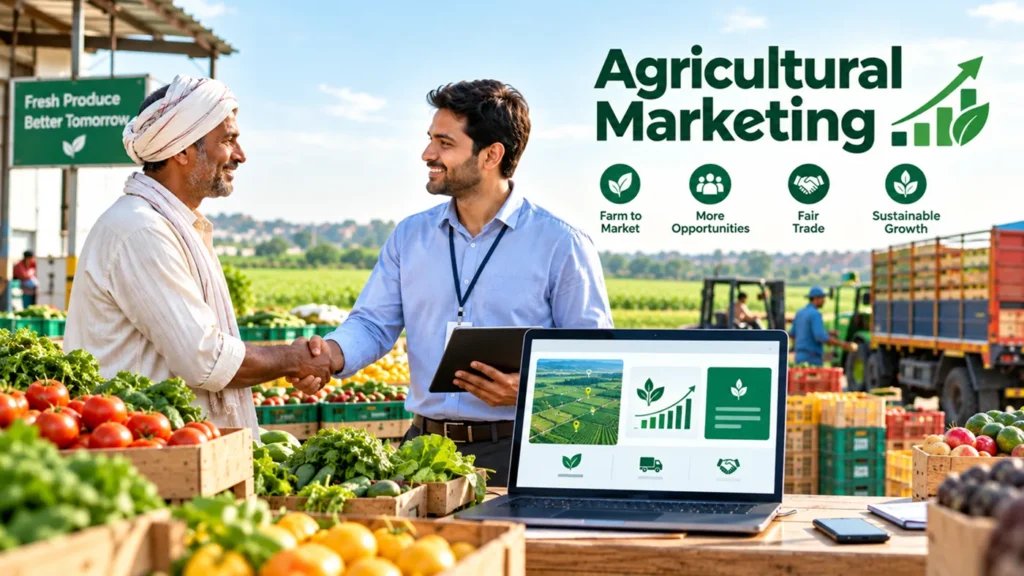
After the crops are ready to reach us, what is the link that connects farms to markets? It is agricultural marketing, which handles the whole process of bringing agricultural products to their final consumers. Agricultural markets are the networks that move farm produce, livestock, and raw materials from farms to consumers. This sector of the market handles various levels of responsibilities, such as production, processing, storage, transportation, and distribution. These markets ultimately make it easier and more accessible for food to reach consumers, but also provide work opportunities to every single person involved in this chain of networks from farm to market.
To know more about how agricultural markets work, their advantages, and the challenges they face, continue reading:
What is Agricultural Marketing?
Agricultural marketing is the process by which agricultural products are taken from farmers to consumers via various stages including collection, storage, transportation, processing, pricing, and selling. It enables farmers to secure buyers for their crops at the same time as ensuring that food and other agricultural products get to the markets efficiently.
An agricultural market consists of a series of steps that begin when a crop leaves the farm and goes to a wholesaler, retailer, food processor, or directly to the consumer. Such a system enables farmers to obtain fairer prices, helps to reduce post-harvest losses, and also improves access to wider markets.
In India, agricultural marketing is important since millions of farmers rely on the sale of their crops and other farm products for their living. The method in which agricultural products are marketed is now being greatly altered because of the growth of digital marketplaces, organized supply chains, food processing and direct-to-consumer models.
Different Types of Agricultural Marketing
The way in which agricultural marketing is carried out can differ according to who purchases the produce, where it is sold, and the method by which it gets to the final consumer. Each of these approaches provides farmers with different options for selling their crops and other agricultural products.
Local or Direct Marketing
In this method, farmers sell their produce directly to the consumers, through local markets, farm stalls, or roadside shops. This method decreases the number of intermediaries involved and allows farmers to receive a better share of the final price.
Wholesale Marketing
Farmers sell their produce in larger quantities to wholesalers, who then supply it to retailers or other businesses. This is used commonly for crops, grains, fruits, and vegetables.
Cooperative Marketing
In this case, farmers form a cooperative in order to market their crops together. When they combine their products, they are able to strengthen their bargaining position, lower some of their marketing costs, and may thereby gain access to bigger markets.
Contract Marketing
With contract marketing, farmers enter into advance agreements with a company, a processor, or a buyer to produce certain agricultural products under set conditions. These agreements can indicate such things as the quantity, the quality, the price, and the delivery.
Digital or Online Marketing
Technology has created new ways for farmers to reach buyers. Either through online marketplaces, electronic platforms, or electronic trading systems, agricultural produce can be marketed past traditional local markets, improving access to price information and potential buyers.
Importance and Need for Agricultural Markets
Agricultural markets play an important role as a connection between farmers and consumers. While production is only one aspect of farming, it is essential that farmers have reliable markets in which they can sell their crops at a fair price. When agricultural markets are well organized, they help to ensure a more seamless transition of goods from the farm to the final consumer.
Helps Farmers Get Better Prices
Agricultural markets give farmers access to buyers and price information, helping them make good, profit friendly decisions about when to sell which reduces their reliance on a single buyer.
Connects Farmers with Consumers
Markets connect people who produce agricultural products with those who consume them. They enable crops, fruits, vegetables, and dairy products to be transported efficiently from farms to households, to retailers, and to the food processing industries.
Reduces the Role of Unnecessary Intermediaries
A properly working market system can cut down on overreliance on middlemen and enable farmers to keep a larger portion of the value created by their crops.
Reduces Post-harvest Losses
Appropriate methods of storing, transporting, grading and packing contribute to the protection of agricultural products against deterioration and damage, especially in the instance of fruits and vegetables.
Provides Market and Price Information
Farmers ought to know the value of their crops and where demand is greater. The agricultural markets provide useful information on prices, demand, quality requirements, and market patterns, which in turn assists farmers with planning their production and sales.
Also Read: AI in Agriculture: Transforming Modern Farming with Smarter Technology
Benefits of Agricultural Marketing
An effective agricultural marketing system brings benefits not only to farmers but also to consumers, traders, and the broader agricultural economy; it achieves this by improving price discovery and reducing wastage, thus enabling agricultural products to be transported more efficiently from farm to market and finally to the consumer.
Better Returns for Farmers
Efficient marketing allows farmers to have access to a greater number of buyers and enables them to make decisions regarding where and when to sell their produce, thus improving their chances of getting a fair price.
Wider Market Access
Farmers have the possibility of getting their crops to markets outside of their local area via wholesalers, cooperatives, organized supply chains, and electronic platforms. This in turn gives them the chance to sell to a wider customer base.
Reduction in Post-harvest Losses
Correct storage, transport, packaging, and processing can both prevent crops from spoiling and reduce physical damage, in the case of perishable items like fruits and vegetables.
Improved Price Discovery
Agricultural markets provide information about necessary prices, demand, and quality requirements. Better access to this information allows farmers to make better and more efficient selling decisions.
Encourages Quality Production
When markets reward better quality produce, farmers have greater motivation to adopt improved farming and post-harvest practices. This may result in higher quality agricultural products reaching consumers.
Challenges of Agricultural Marketing
Agricultural marketing comes up against a number of difficulties which can have an effect on farmer’s incomes and on the way in which produce is moved from farm to market. These problems affect small and marginal farmers since they may have limited access to organized markets.
Price Fluctuations
Insufficient access to warehouses, cold storage and other preservation facilities can force farmers to sell their produce soon after harvesting. Sometimes at even lower prices.
Lack of Storage Facilities
A farmer may be forced to sell their crops after harvesting because they have inadequate access to warehouses, cold storage, and other preservation facilities.
Poor Transportation
Limited transport availability and high transport costs make it difficult to move agricultural products from rural areas to larger markets, which also increases the risk of damage and spoilage.
Dependence on Intermediaries
Since farmers often have to rely on traders or intermediaries in order to get access to markets—especially in the case where they do not have direct links with buyers—this can result in a decrease in their bargaining power and in the portion of the final price that reaches the consumer.
Lack of Grading And Standardization
The quality, size, and degree of maturity of agricultural products can influence their value. If grading, sorting, and standardization are not carried out efficiently, farmers will find it difficult to get prices that justify the quality of their crops.
Strategies for Effective Agricultural Marketing
Effective agricultural marketing requires more than simply finding a buyer to sell the produce. Farmers and agricultural businesses need and use different strategies that improve market access, reduce losses, increase bargaining power, and add value to the farm produce.
Value Addition
Rather than merely selling unprocessed crops, farmers could consider the possibility of processing and packaging their products. For example, products like fruit juices, flour, pickles, spices and dairy products can add value and may thus improve their returns.
Better Storage and Transportation
Investing in warehouses or in cold storage facilities, packaging, and efficient transit can further reduce post-harvest losses and allow farmers to hold produce until more favorable market conditions arises.
Grading, Sorting and Standardization
Properly grading and sorting agricultural produce according to quality, size and other important standards can improve its marketability and help farmers target buyers willing to pay for higher quality products.
Market Research and Price Awareness
Farmers should keep a track of market prices, consumer demand, seasonal trends, and buyer requirements on a regular basis, as access to reliable information can further help them to decide what to produce, where to sell it, and when to sell.
Discovering New Markets
Farmers can expand past traditional local markets by targeting regional, national, and international buyers. Diversifying markets and their reach for profit and accessibility, can reduce dependence on a single marketplace and create new income opportunities.
Is Agricultural Marketing Profitable?
Agricultural marketing can play an important role in improving the profitability of farming by helping farmers find better markets, reduce losses and increase the value of their produce. Profitability depends not only on how much a farmer produces, but also on how efficiently that produce is stored, priced, processed and sold.
Better Price Realization
Farmers will be able to find good prices and can prevent themselves from having to sell their crops under undue pressure because they have access to a number of buyers and to reliable market information.
Reduced Post Harvest Losses
Efficient storage, transportation and handling can reduce deterioration and wastage. Lower losses mean that a great proportion of the harvested produce can actually be sold.
Lower Marketing Costs
Cooperative selling, bulk transportation and organized supply chains can help reduce expenses related to transportation, packaging, storage and handling, while also improving the farmer’s net income.
Value Addition
Processing agricultural products can increase their market value. and for that to happen, farmers sometimes convert raw fruits into juice, pulp, or preserves, creating additional revenue opportunities.
Access to Premium Markets
Farmers producing organic or high-quality products may be able to access markets where consumers are willing to pay more for specific set of qualities, certifications, or production practices.
FAQs about Agricultural Marketing
Agricultural marketing is an element of the farming ecosystem because it links farmers, markets, and consumers and affects how efficiently agricultural products reach their final destination.
Whether they are drawing on traditional local markets and cooperatives or using electronic platforms and direct-to-consumer models, effective marketing can enable farmers to obtain better prices, cut down on post-harvest losses and gain access to broader markets.
Problems such as price fluctuations, inadequate storage facilities, transportation difficulties, and a lack of market information still affect agricultural profitability. Improving infrastructure, introducing technology, and promoting value addition can create a more efficient and effective marketing system that benefits each and everyone involved in this chain.
In the end, effective agricultural marketing helps sell produce, turns agricultural production into a more stable source of income, and thus, creates stronger, longer-lasting opportunities for farmers.