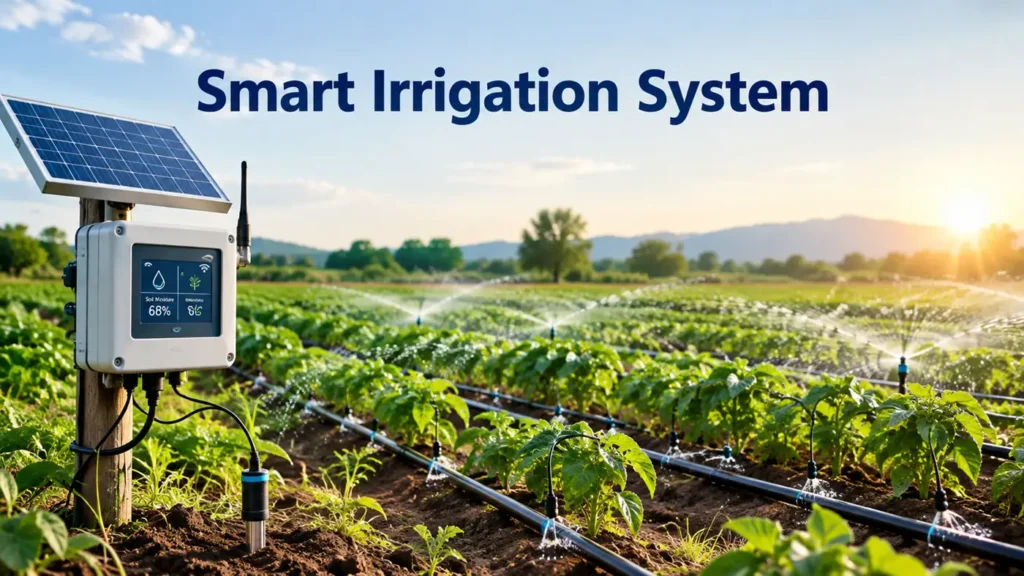
Smart Irrigation System
Water is one of the most essential resources in agriculture. Through Traditional irrigation systems, water is misused, such as overwatering, poor distribution, and incorrect timing. Smart irrigation systems improve on conventional irrigation by minimizing water waste, increasing productivity, and saving money.
Using modern technology in irrigation means involving the use of sensors, which measure the amount of soil moisture, the use of weather data, and automated controls that enable watering to take place according to the field situation, rather than a scheduled irrigation process.
What is Smart Irrigation?
Smart irrigation is a brilliant way of watering plants, lawns, or crops using technology.
Unlike traditional sprinkler systems that run on a fixed timer—watering even when it is raining—smart irrigation automatically adjusts its watering schedule based on real-time needs.
The main Parameters on which Smart irrigation relies are:
- Soil moisture: Measures how wet or dry the soil is to avoid watering ground that is already damp.
- Weather forecasts and rainfall: Tracks real-time weather and upcoming rain predictions to skip watering cycles automatically when rain is expected.
- Temperature: Monitors daily heat levels, as higher temperatures cause water to evaporate faster from plants and soil.
- Humidity: Measures atmospheric moisture, which affects how quickly plants transpire and lose water.
- Wind speed: Detects high winds, which can blow sprinkler spray off-target and increase surface evaporation.
- Solar radiation: Tracks sunlight intensity to calculate evapotranspiration rates (how much moisture plants and soil lose throughout the day).
- Plant type and crop needs: Factors in specific plant species, root depths, and growth stages to deliver the exact hydration required.
- Soil type: Takes into account whether the soil is sandy, clay, or loam to adjust watering speed and prevent runoff.
How does the Smart Irrigation work?
A Smart Irrigation System functions through a continuous, automated loop that replaces rigid timers with real-time environmental intelligence.
Here is how it works step by step:
- Data collection: Weather stations and sensors continuously gather live data, including local rainfall forecasts, temperature, humidity, wind speed, sunlight intensity, and
real-time soil moisture levels. - Analysis and calculation: The smart controller processes this incoming data using evapotranspiration (ET) algorithms to determine exactly how much moisture plants and soil are losing.
- Automated decision-making: The system compares the plant’s actual water requirements against the current soil state; if rain is predicted or the ground is already sufficiently moist, it automatically pauses or adjusts the watering schedule.
- Precise delivery: The controller sends signals to electronic valves to open and water specific zones precisely when and where hydration is needed, ensuring zero water waste.
Advantages of Smart Irrigation Systems
Smart irrigation systems replace traditional, timer-based watering with real-time data driven by IoT (Internet of Things) tech.
Here is a full, multi-part overview covering every critical aspect of the technology:
- Significant water conservation: Saves 30% to 50% more water compared to traditional systems by eliminating over-watering and skipping cycles during rainfall.
- Cost savings: Lowers monthly water and electricity bills; off-peak scheduling options reduce energy tariffs.
- Healthier plants and higher crop yields: Prevents root rot, fungal infections, and soil nutrient leaching by delivering precise hydration tailored to root depths.
- Labor automation: Eliminates the manual effort required to adjust schedules, inspect field moisture, or physically open and close valves.
- Remote control and alerts: Offers smartphone or cloud dashboard connectivity to
control zones, adjust settings, and receive immediate alerts for pipe bursts or leaks. Applications of Smart Irrigation Systems
Sector Primary Application
- Agriculture Precision crop farming, drip/micro-irrigation, vineyard moisture management, and large-scale greenhouse climate control.
- Commercial Landscapes Golf courses, public parks, sports stadiums, corporate campuses, and municipal street green belts.
- Residential Gardens Automated lawn sprinklers, residential rooftop gardens, flower beds, and home vegetable patches.
Key Components of a Smart Irrigation System
- Smart Controller: The “brain” of the system (weather-based signal controllers or sensor-based controllers) that processes data and executes schedules.
- Sensors:
- Soil moisture sensors: Placed at root zones to measure volumetric water content.
- Rain/freeze sensors: Shut off the system immediately during heavy rain or freezing temperatures.
- Flow sensors: Detect abnormal water pressure changes to identify leaks, pipe bursts, or clogged heads.
- Weather Stations: Local or web-connected hubs measuring temperature, humidity, solar radiation, and wind speed to calculate Evapotranspiration (ET).
- Solenoid Valves: Actuators that physically open or close water flow to specific zones upon receiving electric signals from the controller.
- Connected App / Cloud Platform: Software interfaces allowing users to monitor operations, receive analytics reports, and override schedules remotely.
Challenges Facing Smart Irrigation Systems
- High upfront costs: Higher initial investment compared to standard timers, particularly for large farms or commercial properties.
- Connectivity dependence: Sensor nodes and controllers require reliable Wi-Fi, cellular, or LoRaWAN networks; outages interrupt real-time updates.
- Sensor calibration & maintenance: Soil sensors can corrode over time or fail if buried in high-salinity soils, requiring periodic maintenance and recalibration.
- Technical complexity: Small-scale farmers or homeowners may face a learning curve in initial configuration, zone setting, and app navigation.
Tips on Maximising Benefits from Smart Irrigation Systems
- Perform zone-based grouping: Group plants with similar water needs together (hydrozoning) so each line delivers the correct quantity without overwatering neighboring species.
- Proper sensor placement: Install soil sensors in active root zones away from direct sprinkler hit paths or unnatural shade spots to avoid skewed readings.
- Regular maintenance checks: Routinely inspect sprinkler heads, flush filter lines, clean flow sensors, and check pipe connections for micro-leaks.
- Integrate live weather data: Ensure your controller links directly to a reliable local weather service API for accurate localized forecasts.
The Future of Smart Irrigation
- AI and Predictive Analytics: Systems will move beyond reactive watering to predictive models, analyzing historical weather data and machine learning to optimize watering schedules days in advance.
- Satellite Imaging: Integration with drone and satellite multispectral imaging will allow farmers to identify stressed crops across vast fields without installing
physical sensors everywhere. - Renewable Energy Integration: Expansion of standalone, solar-powered smart irrigation setups designed specifically for off-grid rural farming communities.
FAQs about Smart Irrigation System
Smart irrigation represents a critical shift from guesswork to precision management. By leveraging real-time moisture data, weather forecasts, and automated valves, these systems save millions of liters of water, reduce utility expenses, and support sustainable food production. While initial installation requires capital and minimal technical setup, the rapid return on investment through resource savings makes smart irrigation an indispensable tool for modern landscapes and agriculture.