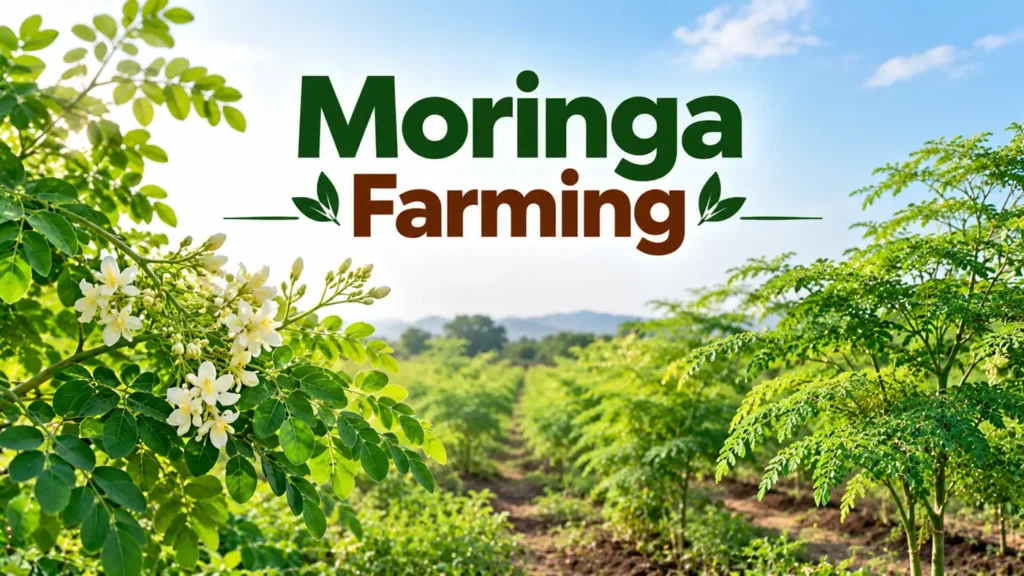
Moringa farming has attracted growing interest as demand for moringa leaves, pods, powder, seeds, and oil increases. Scientifically known as Moringa oleifera, moringa is a fast-growing tree that is well suited to many tropical and subtropical conditions.
Farmers can have a number of possible sources of income since various parts of the plant can be sold. Yet profitability is by no means certain and will depend on factors including the choice of variety, the climate, irrigation, labour costs, crop management, the yield, and the market prices.
Climate and Soil Requirements
Moringa does well in warm climates and needs adequate sunlight and good drainage in order to grow healthily; it is important to have well-drained land since waterlogged soils can have a negative effect on the crop.
After it has been established the crop can withstand fairly dry conditions, but it is necessary to have sufficient water available when it is being established and during periods of active growth. Assessment of the soil’s fertility and the local environmental conditions should take place before planting.
Selection of Varieties
One of the first choices that farmers make when engaging in commercial moringa farming is the selection of an appropriate variety. When making their choice they may take into account features such as pod production, growth rate, branching pattern, and adaptability to the local climate.
PKM-1 and PKM-2 are examples of improved varieties used in commercial production. However, the most suitable variety can vary according to the intended market and local growing conditions.
Land Preparation and Planting
Prepare the field to provide adequate drainage and suitable conditions for root development. Moringa can be established from seeds or planting material, depending on the production system.
Spacing should be selected according to the purpose of cultivation. Farmers growing moringa primarily for leaves may use a different planting density from those producing long pods. Commercial farmers should therefore plan spacing according to their target product and available resources.
Irrigation and Nutrient Management
Even though moringa is fairly tolerant of dry conditions, irrigation can help with establishment and production, especially when there is insufficient rainfall. The quantity and how often irrigation is carried out should be based on the type of soil, the climate, the age of the plant, and the amount of rainfall.
Nutrient management must be based on the conditions of the soil and on the needs of the crops; the use of too much fertilizer without first evaluating the fertility of the soil can lead to higher production costs and might have a negative effect on the environment.
Pruning and Crop Management
Pruning is an important management practice in commercial moringa production. It can encourage branching, maintain a manageable plant height and make harvesting easier.
Regular monitoring is also necessary to identify weeds, pests, and diseases at an early stage. Appropriate integrated crop-management practices can help reduce unnecessary chemical use while protecting crop productivity.
Harvesting Moringa
The methods used for harvesting will vary according to the product in question; in the case of young leaves they are picked at regular intervals, whereas the pods are usually harvested when they have reached the stage required for eating or processing.
Farmers producing seed or oil may allow pods to mature further so that seeds can develop fully. Harvest timing can therefore have a direct effect on product quality and market value.
Moringa Processing and Value Addition
One advantage of moringa cultivation is the possibility of value addition. Fresh leaves can be dried and processed into moringa leaf powder, while seeds can be used for oil production.
Proper drying, cleaning, storage, and packaging are important for maintaining quality. Processing can potentially extend shelf life and allow farmers or businesses to access markets beyond the local fresh-produce market.
Economic Potential of Moringa Farming
Moringa can provide multiple potential sources of income through the sale of leaves, pods, seeds, powder, and oil. Demand from food, wellness and personal-care industries has also contributed to interest in commercial production.
Profitability is determined by the entire economics of cultivation, the costs involved including land preparation, planting material, irrigation, fertilisers, labour, pest management, harvesting, transport and processing.
Getting access to the market is just as important; a crop that gives a high yield might not be profitable if the farmers have no sure buyers or if the transportation and processing costs are high. Farmers ought to identify possible markets before they make investments in large-scale production.
Challenges in Moringa Farming
Moringa farming faces several challenges. Farmers may deal with changes in market prices, labor needs pest and disease problems, and trouble keeping product quality steady.
Post-harvest handling is another important concern, particularly for leaves and fresh pods, which can lose quality if not handled and transported in an appropriate manner; for processed products such as leaf powder and oil, proper hygiene, drying, storage, and packaging are essential.
FAQs about Moringa Farming
Moringa farming can offer opportunities for agricultural diversification because the crop provides multiple products and can be cultivated in suitable tropical and subtropical environments. Leaves, pods, seeds, and value-added products can serve different markets.
Successful commercial cultivation of moringa trees involves more than just planting them. Farmers must choose the right varieties, look after the irrigation and the nutrients, properly look after the crop and harvest it at the correct stage. If appropriate planning is carried out and the local conditions are suitable, moringa can become a potentially useful part of a diversified farming operation.