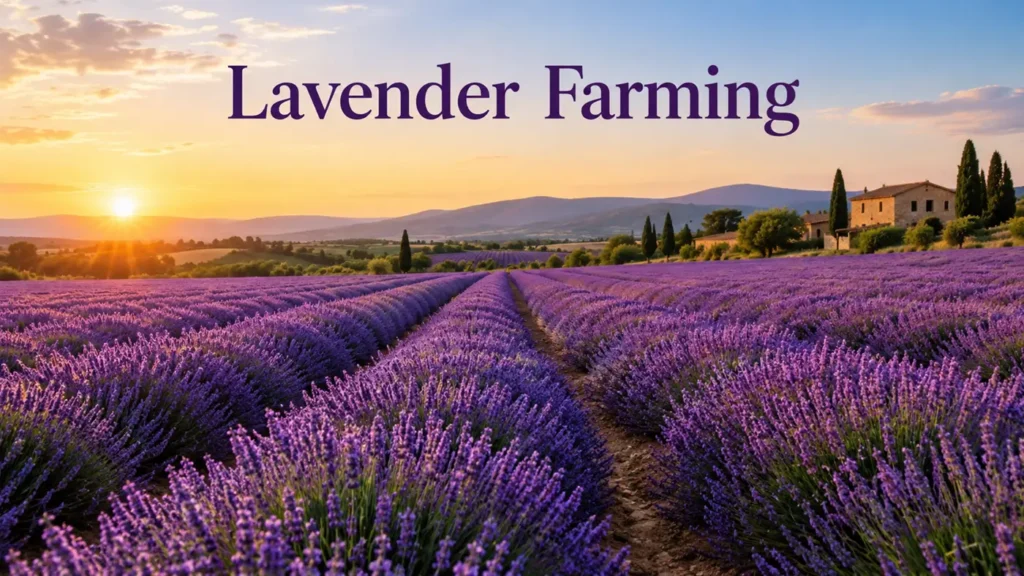
Lavender farming involves growing lavender plants in order to obtain their fragrant flowers, essential oils, and for a variety of commercial uses. Because of its attractive purple flowers and unique smell, lavender is a significant aromatic crop and is widely used in the cosmetics, perfumery, herbal products, and wellness sectors. The increasing demand for lavender has led farmers to look into raising it as a possible means of earning an agricultural income. Lavender can be grown as a valuable commercial crop provided that the right climate conditions are met, suitable soil management is carried out, and appropriate farming methods are used.
What is Lavender Farming?
Lavender farming involves cultivating plants belonging to the Lavandula genus, which includes several species valued for their fragrance and essential oil content. The flowers contain aromatic compounds that are extracted and used in perfumes, soaps, skincare products, and other commercial goods.
Lavender is a perennial plant and therefore is able to grow and produce flowers for several years provided that the conditions are suitable. It usually grows well in areas that receive plenty of sunlight, together with soil that drains well and fairly dry conditions. The plant can be grown for the purpose of producing essential oil, for use in dried flowers, as an ornamental plant, and for culinary use, according to the species and variety.
In certain areas of Jammu and Kashmir, particularly those with favorable climate conditions, there is an increasing interest among farmers in cultivating lavender. This enables them to diversify their crops and become involved in the growing market for aromatic and medicinal plants.
Suitable Climate and Soil for Lavender Farming
Climate and soil conditions play an important role in the successful cultivation of lavender.
Climate
Lavender generally prefers sunny conditions, moderate temperatures, and relatively low humidity. Wide varieties tolerate dry weather once established, although young plants require adequate moisture during establishment.
Soil
It is important to have well-drained soil since waterlogged conditions can harm the roots and raise the chance of fungal diseases. Soils that are sandy, gravelly, or loamy might be appropriate, depending on whether they drain well and their nutrient properties.
Sunlight
For lavender to grow healthily and produce flowers, it needs a lot of sunlight. Places that get about six to eight hours of direct sunlight each day are usually appropriate.
Water Availability
Even though lavender is fairly drought-tolerant once it has been established, watering may still be necessary during dry times, particularly in the early phase of its growth.
Land Preparation
Fields should be prepared to ensure good drainage and suitable soil structure. Raised beds may be useful in locations where excess water is a concern.
Steps Involved in Lavender Cultivation
To be successful in lavender farming, it is necessary to carry out careful planning and maintain consistent crop management.
Variety and Required Conditions
When choosing a variety of lavender, farmers should take into account the local climate, the soil conditions, the purpose for which it is to be grown, and market demand; the varieties selected for the production of essential oil may be different from those that are preferred for the ornamental or dried-flower markets.
Propagation
Lavender may be propagated using seeds or by means of vegetative methods such as stem cuttings. Stem cuttings are generally preferred when growing lavender commercially since they help to preserve the features of the chosen plants.
Planting
Seedlings that are in good health or rooted cuttings are transferred into fields which have been prepared with appropriate spacing. The time for planting will vary according to the local climate and the availability of irrigation.
Irrigation
Regarding irrigation, young plants need to be watered regularly until their roots have become established; afterward, the irrigation should be adjusted in accordance with the rainfall, the soil moisture, and the requirements of the plant. It is important to avoid overwatering.
Weed Management
Weeds compete with lavender plants for nutrients, water, and sunlight. It is possible to keep their growth under control by weeding regularly, applying mulch, and carrying out proper field management.
Pruning
This practice aids in keeping the plant’s shape, promotes healthy growth, and may help achieve productive flowering. It is advisable to avoid cutting back too severely into old and woody growth since some lavender plants may not recover well from it.
Harvesting
The harvesting of lavender flowers depends on their intended use and the stage at which they are flowering. When the flowers are to be used for the extraction of essential oil, they are generally picked at a time when their aromatic compounds are appropriate for processing, whereas in the case of producing dried flowers, the harvesting and drying must be carried out carefully in order to retain their color and scent.
Uses of Lavender
Lavender is used in a number of areas within the agricultural, commercial, and household sectors.
Production of Oils
The production of essential oil involves processing the flowers of lavender, and this essential oil is commonly used in the field of perfumery, in fragrances, and in certain personal-care products.
Different Products Derived
In soaps, creams, lotions, shampoos, and other personal-care products, lavender-derived ingredients are used.
Aromatherapy Products
Lavender scent is generally included in fragranced oils, candles, sachets, and other products designed for relaxation. Yet, it should not be assumed that assertions regarding the treatment of medical conditions are valid without reliable evidence.
Decorative Use
Dried lavender flowers are used in potpourri, in floral arrangements, in decorative bundles, and in scented sachets.
Culinary Use
It is possible to use certain types of lavender in small amounts to flavor baked goods, beverages, and other foods, on the condition that the plants are appropriate for culinary purposes and have been grown and handled in a safe way.
Ornamental Landscaping
Lavender is also cultivated in gardens, parks, and commercial landscapes because of its attractive flowers and pleasant fragrance.
Benefits of Lavender Farming
Lavender cultivation offers several potential advantages for farmers and agricultural businesses.
Multiple Revenue Opportunities
Farmers may sell fresh flowers, dried flowers, planting material, or essential oil, depending on their production capacity and access to markets.
Efficient & Long-Lasting Use
Lavender, which has been grown for a long time, can bloom for many years when the conditions are right, thus eliminating the need to replant it every year.
Value Addition
There is a possibility of adding value by processing lavender into essential oil, dried bunches, or packaged products.
Requires Less Water
Lavender varieties generally need little water once established; they can endure dry conditions, but proper irrigation is still important during establishment and during long periods of drought.
Agritourism
Lavender fields could draw in visitors for the purpose of photography, for seasonal tourism, for educational activities, and for farm-based experiences provided that the locations are suitable.
Challenges in Lavender Farming
In Terms of Climate
Lavender does not grow equally well in all areas; plant growth and flowering can be affected by too much humidity, bad drainage, or inappropriate temperatures.
The Initial Investment
Setting up a commercial lavender farm will involve spending money on planting material, land preparation, irrigation, and harvesting equipment.
For the Control of Pests and Diseases
Root rot and other fungal diseases may occur when the soil is poorly drained or too wet. It is necessary to carry out regular monitoring and apply suitable crop management practices.
Processing Requirements
Essential oil production may require specialized distillation equipment or access to a processing facility.
Market Access
Farmers need reliable buyers and information about the quality standards required for essential oils and dried flowers. Prices may vary according to product quality, demand, and supply.
Time to Commercial Production
Lavender plants may require time to establish before reaching productive yields. Farmers should plan their finances and marketing arrangements accordingly.
Lavender Farming in India
In certain regions of India, particularly in Jammu and Kashmir, the growing of lavender has attracted attention because some of these areas provide suitable conditions for cultivating aromatic crops. Because of the various schemes promoting the cultivation of aromatic plants, farmers have begun to see lavender as an alternative to their traditional forms of agriculture.
Lavender is not suitable for every part of India, and before starting to grow it, farmers ought to evaluate the local temperature patterns, the humidity level, the soil drainage, the availability of water, and the presence of processing facilities.
Farmers should also, before making an investment, find out who the possible buyers are, look into local agricultural support schemes, and work out the costs of setting up and operating. Farmers can make use of contacts with agricultural universities, horticulture departments, and other relevant research organizations when choosing suitable varieties and when adopting the right cultivation methods.
FAQs about Lavender Farming
Lavender farming represents a promising type of aromatic crop farming since it involves not only agricultural production but also possibilities in the areas of essential oils, cosmetics, decorative items, and agritourism. The fact that it is a perennial crop, has a particular scent, and has a variety of commercial applications makes it a worthwhile choice for crop diversification in appropriate areas. However, successful farming of lavender requires favorable climate and soil conditions, efficient crop management, suitable processing facilities, and access to a reliable market. If adequate planning is carried out and value is added to the product, lavender farming can help promote agricultural diversification and support economic development in rural areas.