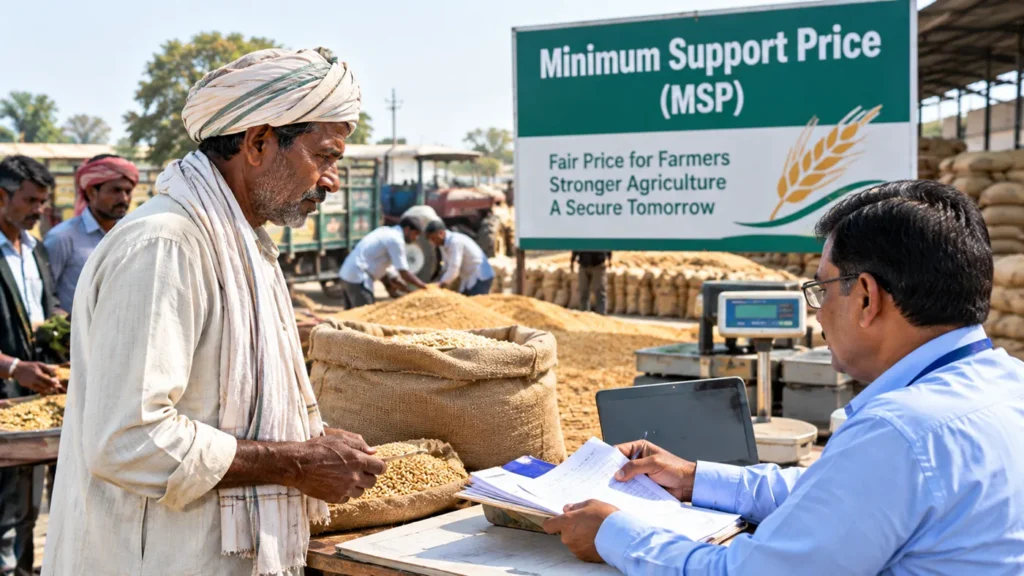
Minimum Support Price
For a farmer, selling their crop is not merely the last stage of cultivation since it is at this point that months of hard work, investment and risk have to be turned into income. However, agricultural prices can undergo sharp fluctuations due to supply and demand, weather conditions and market conditions. One of the main policy measures used by the Government of India to ensure that farmers receive a certain price for certain agricultural crops is the Minimum Support Price (MSP).
The price which the government announces for certain crops is intended to protect farmers against a sudden drop in market prices and to ensure that they receive a remunerative return. Each year the government sets the MSP for 22 crops which are required by law, on the basis of the recommendations of the Commission for Agricultural Costs and Prices (CACP) and after having taken into account the opinions of the state governments and the relevant central ministries.
In 2026 the MSP system remains an important element of India’s agricultural policy, especially since the country is aiming at boosting farm incomes, promoting crop diversification and enhancing food security.
What is MSP?
Minimum Support Price (MSP) is the price determined by the government at which selected agricultural products can be procured from farmers through government-designated agencies, based on the relevant procurement mechanisms.
The fundamental principle of MSP is simple in that if farmers encounter low market prices then the government’s purchase at MSP can give them some degree of price protection.
It is important not to regard MSP as a fixed selling price that is guaranteed to all farmers. The benefit which a farmer actually receives will vary according to factors such as whether the crop is obtained in the farmer’s own area, whether the farmer fulfils the procurement requirements, the quality of the crop and the availability of procurement infrastructure.
How is MSP Determined?
The Commission for Agricultural Costs and Prices (CACP) suggests minimum support prices for compulsory crops. Before declaring the minimum support prices, the government takes into account the CACP’s recommendations as well as the opinions of the state governments and the relevant central ministries and departments.
The government’s MSP framework takes into account a number of factors such as production costs, conditions relating to demand and supply, domestic and international prices, the price relationships between different crops, and the effects on the economy as well as on the interests of both consumers and producers.
The government has, since the 2018-19 season, adhered to the principle which was announced whereby the minimum support price is set at at least 1.5 times the all-India weighted average cost of production for the crops that are mandated.
How Many Crops are Included Under the MSP?
As of 2026, MSP is fixed annually for 22 mandated crops:
- Kharif Crops
- Rabi Crops
- Wheat
- Barley
- Gram
- Lentil
- Rapeseed & Mustard
- Safflower
- Commercial Crops
- Jute
- Copra
Importance of MSP In Indian Agriculture
MSP has several roles in India’s agricultural economy.
1. Provides Price Protection
Agricultural markets are difficult to predict. If the government carries out procurement, the MSP will give farmers some protection against sharp falls in prices.
2. Supports Farmer Income
The MSP could assist in improving farmers’ income prospects by establishing a rewarding standard for certain crops.
3. Encourages Crop Production
A more clear-sighted forecast of prices can cause farmers to keep on producing important agricultural products.
4. Supports Food Security
The way in which the government purchases crops such as paddy and wheat helps to support the nation’s food-grain procurement and public distribution systems.
5. Encourages Crop Diversification
If higher minimum support prices are given for pulses, oilseeds and nutri-cereals, farmers might consider growing crops besides traditional cereals, the government having clearly identified MSP as one of the means of promoting such diversification.
Also read: What is Agricultural Marketing?
Advantages of MSP (Minimum Support Price)
1.Reduces Price Risk
If procurement is available, the MSP will afford farmers against the entire impact of sudden falls in market prices.
2. Improves Income Stability
A reliable procurement system can make farmers’ incomes a little more predictable, particularly where market prices are low.
3. Promotes Investment in the Field of Agriculture
With better price assurance, farmers will become more confident when investing in seeds, machinery, irrigation, and other agricultural inputs.
4. Strengthens Food Security
The fact that government purchases carried out under the MSP leads to food grains being available for public food-security programmes.
5. Promotes Strategic Crops
The rise in MSPs for pulses, oilseeds and millets can help the government in its aim of promoting production in addition to rice and wheat.
Challenges Faced By MSP
1. Limited Procurement Coverage
Although MSP has been announced for 22 crops, government procurement is not the same in all crops or in all regions. It therefore follows that the fact that MSP has been announced does not mean that every farmer can sell their entire harvest at that price.
2.Regional Differences
The procurement infrastructure varies from some states and regions to others and farmers in areas where there are fewer procurement centres might find it difficult to access procurement based on the MSP.
3.Small Farmers
Small farmers could have trouble getting their crops to the procurement centres or fulfilling the requirements regarding quality and quantity, in particular if they need some cash right after harvesting.
4.The Limitations Relating to Storage and The Market
Farmers who do not have adequate storage facilities might be compelled to sell their crops immediately after harvesting, even if the market prices are low.
5.The Risk of Crop Imbalance
Since a high degree of concentration of procurement and production is centered on certain crops, there are worries regarding crop diversification, water usage and soil sustainability. It is therefore important to promote pulses, oilseeds and millets by means of suitable price and procurement policies.
What’s the Difference Between MSP and Market Price ?
MSP refers to the price which the government declares for certain crops, whereas the market price is the price at which the commodity is actually traded in the market.
Market prices may be either above or below the MSP according to supply, demand, quality, location and other market conditions.
For instance, if the market price for a crop is above the MSP a farmer might decide to sell via the open market; if prices drop below the MSP then government procurement, which is available can offer an alternative method of selling.
MSP should not therefore be regarded as being the same as the actual market price.
Role of MSP in Crop Diversification
The agricultural policy of India has increasingly aimed at getting farmers to grow a more varied range of crops, especially pulses, oilseeds and nutri-cereals.
It is important since a heavy reliance on a small number of crops can lead to problems concerning nutrition, imports, water use, and soil health.
The MSP declarations for 2026–27 still offered returns that were relatively high compared to the government’s estimated cost of production for a number of pulses and oilseeds. For instance, the margin estimated for moong was 61 per cent, rapeseed and mustard had a margin of 93 per cent and lentil had a margin of 89 per cent for the 2026–27 Rabi season.
Profitability
The fact that MSP does not imply that all farmers will make a profit is still the case, but it can affect the profitability of farms in a number of ways.
1.Offers A Price Benchmark
MSP provides farmers with a benchmark against which to assess market prices and on the basis of which to decide where and when to sell their crops.
2.Generates A Potential Margin Above Production Cost
For the 2026–27 Kharif crops the government expects its margin to be between 50 per cent and 61 per cent above the All-India weighted average cost of production, the highest margin anticipated being for moong at 61 per cent. The expected profit margins for Rabi crops vary from 50 per cent for safflower to 109 per cent for wheat.
3.AIDS in The Recovery of Cultivation Costs
If prices obtained through procurement at MSP are high enough, they will enable farmers to cover their costs of cultivation and also yield a return in excess of the government’s estimated cost of production.
4. Minimizes the Effect of Market Recessions
Where available, buying at the MSP can lessen the financial effect on the participating farmers if the open-market prices drop considerably.
5. Improve Long Term Farm Planning
Better price transparency can help farmers to make more well-informed decisions regarding which crops to grow, their investments, and their production planning.
It should not be understood that the government’s calculated “margin over cost” represents guaranteed net earnings for all farmers; profitability in fact depends on the size of the farm, its location, the yield, the costs of inputs, labour expenses, access to the market, and on whether the farmer is able to sell at the minimum support price.
Conclusion
The Minimum Support Price is one of the key mechanisms of India’s agricultural policy, designed to protect farmers against severe fluctuations in prices and to ensure remunerative returns for certain crops. In 2026, the government will still set the MSP for 22 crops which are mandated to have it, with the MSPs for the 2026–27 season showing the policy of achieving at least a 50 percent return over the All-India weighted average cost of production.
The latest increase in MSPs has included cereals, pulses, oilseeds and various commercial crops, and the higher level of support being given to crops such as pulses and oilseeds also reflects the broader objective of promoting crop diversification.
At the same time it is true that the minimum support price alone is not capable of overcoming all the problems encountered by Indian farmers. It is just as important to have an effective procurement system, better infrastructure, adequate storage facilities, access to markets and a variety of agricultural opportunities. The real strength of the minimum support price does not consist merely in the figure that is announced, but in the extent to which farmers are able to obtain that price when selling their crops.
FAQs about Minimum Support Price