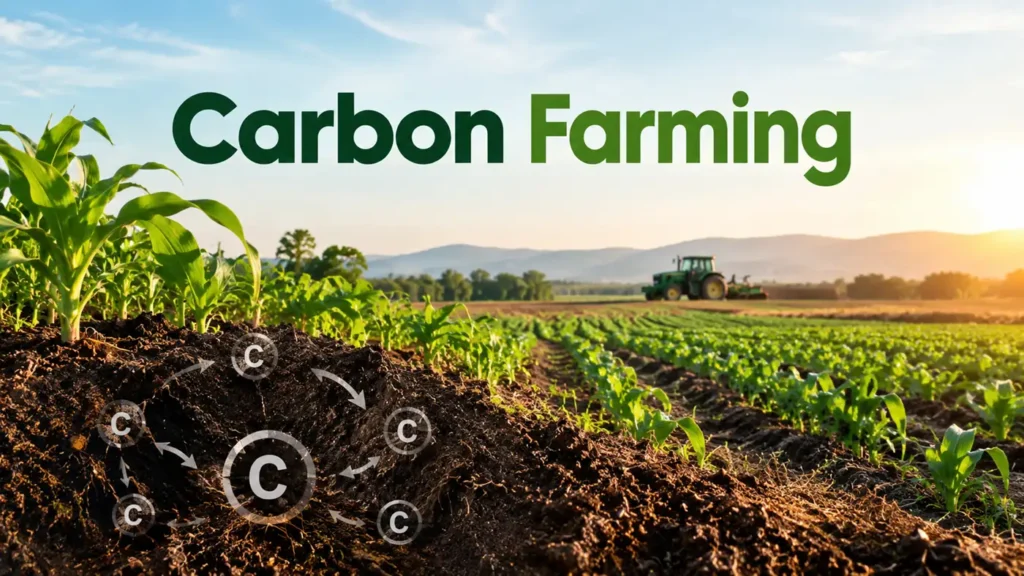
Agriculture is closely connected to climate change because farming activities can both produce greenhouse gas emissions and help remove carbon dioxide from the atmosphere. Carbon farming is an approach to agriculture that focuses on adopting farming practices that increase carbon storage in soil and vegetation while reducing greenhouse gas emissions.
Carbon farming can bring about benefits for both farmers and the environment since it improves soil health, increases the amount of organic matter, and promotes sustainable land management; it can also contribute to achieving climate-resilient agriculture and help in keeping the long-term productivity of farmland.
What is Carbon Farming?
Carbon farming refers to agricultural practices designed to capture and store atmospheric carbon in soils, plants, and other parts of agricultural ecosystems. This process is known as carbon sequestration.
Soils can store large amounts of organic carbon, and practices such as growing cover crops, reducing soil disturbance, planting trees, and the application of organic matter can both boost carbon storage and help to improve soil quality.
Farmers are not obliged to totally alter their present farming methods if they are engaging in carbon farming. Rather, the approach promotes practices which make agricultural production more sustainable and environmentally beneficial.
Major Carbon Farming Practices
Cover Cropping
Cover crops are planted between periods of growing main crops. They help protect soil from erosion and add organic matter to the soil when their roots and plant material decompose. This can contribute to increased soil carbon storage.
Reduced Tillage
Traditional intensive tillage has the effect of disturbing the structure of the soil and can lead to a loss of soil organic carbon. Methods involving reduced tillage and no-tillage minimize disturbance of the soil and thus help to keep carbon in the soil.
Agroforestry
Agroforestry combines trees with crops or livestock on the same land. Trees absorb carbon dioxide through photosynthesis and store carbon in their trunks, branches, roots, and surrounding soil. Agroforestry can therefore provide both environmental and economic benefits.
Crop Rotation
Crop rotation involves growing different crops on the same land in a planned sequence. It can improve soil health, reduce dependence on certain agricultural inputs and support greater biological activity in the soil.
Use of Organic Matter
Applying compost, crop residues and other organic materials can increase soil organic matter. Better soil organic matter can improve soil structure, water retention and nutrient availability while contributing to carbon storage.
Improved Livestock Management
Livestock farming can produce greenhouse gases such as methane. Better feed management, manure management and grazing practices can help reduce emissions and improve the overall sustainability of livestock production.
Benefits of Carbon Farming
Improved Soil Health
Practices involved in carbon farming can boost the amount of organic matter in the soil, improve the structure of the soil, and help beneficial soil organisms. Soils that are in good condition are better at holding onto water and nutrients.
Reduced Soil Erosion
Practices such as cover cropping and agroforestry can protect soil from wind and water erosion. Maintaining vegetation cover helps keep soil in place and preserves its fertility.
Better Water Management
Soils with higher organic matter can generally hold more water. This can improve the ability of agricultural land to withstand periods of limited rainfall and reduce water-related stress on crops.
Climate Change Mitigation
By increasing carbon storage and reducing certain agricultural emissions, carbon farming can contribute to efforts to address climate change.
Increased Agricultural Resilience
Healthy soils and diversified farming systems can make farms more resilient to environmental stresses such as drought, heavy rainfall and changing weather conditions.
Potential Additional Income
In some carbon-farming systems, farmers may be able to participate in carbon-credit programs. Where emissions reductions or carbon storage can be reliably measured and verified, farmers may potentially receive financial incentives for adopting climate-friendly practices.
Challenges of Carbon Farming
Measuring and verifying the amount of carbon stored in agricultural soils can be difficult because soil carbon levels vary according to climate, soil type, land management, and other factors.
Farmers may also need additional knowledge, equipment, or financial support when adopting new practices. Some methods can require an initial investment or changes to established farming systems.
Carbon storage is also not always permanent. For example, carbon stored in soil can be released back into the atmosphere if land management changes or soil is disturbed. Therefore, long-term monitoring and appropriate management are important.
Carbon Farming in India
Carbon farming can have particular relevance in India because of the country’s diverse agricultural systems and large farming population. Practices such as agroforestry, crop diversification, conservation agriculture, improved residue management and the use of organic inputs can support soil health while contributing to climate goals.
For small and marginal farmers, the success of carbon farming depends on whether sustainable practices are affordable, practical and suitable for local conditions. Access to agricultural extension services, technology, finance and reliable markets can help farmers adopt such practices.
Future of Carbon Farming
As interest in climate-smart and sustainable agriculture grows, carbon farming is likely to receive greater attention. Advances in soil testing, remote sensing, digital agriculture and carbon measurement may make it easier to monitor changes in soil carbon.
Carbon farming should not be seen merely as a means of earning carbon credits; its greater value is in improving soil health, in protecting natural resources, in supporting agricultural productivity and in making farming systems more resilient.
FAQs about Carbon Farming
Carbon farming combines agricultural production with practices that can increase carbon storage and reduce certain greenhouse gas emissions. Cover crops, reduced tillage, agroforestry, crop rotation, organic matter management, and improved livestock practices are among the approaches that can contribute to carbon farming.
With appropriate financial support, technical guidance and long-term management, carbon farming can become an important part of sustainable agriculture. It has the potential to benefit farmers while contributing to healthier soils, greater climate resilience and environmental protection.