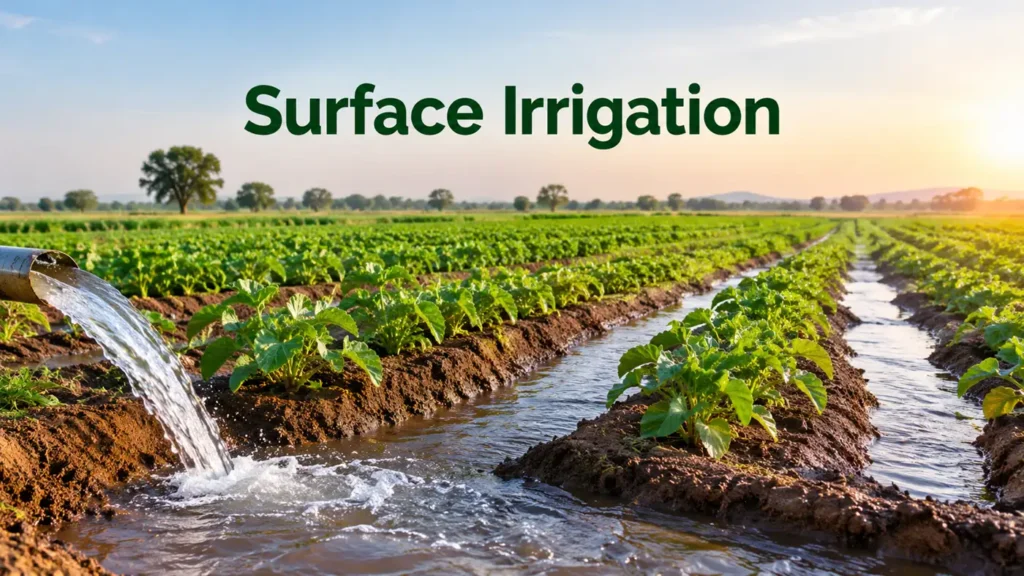
Irrigation is obviously of the utmost importance in agriculture as it provides the crops with the water they need to grow and develop properly. In areas where the rain is unreliable or inadequate, it is essential for maintaining soil moisture and enabling the production of crops. Surface irrigation is one of the most traditional and most widely used methods of irrigation.
This is essentially a gravity-fed system whereby water is distributed across the field by gravity. It’s widely used for the simple reason that it’s so straightforward to operate and requires very little in the way of equipment. Its success is very much dependent on soil type, field slope, the amount of water available, and the quality of irrigation management.
What is Surface Irrigation?
Surface irrigation is a method of watering crops in which water flows over the soil surface and infiltrates into the ground to supply moisture to plant roots. Water is generally supplied through canals, field channels, or other suitable distribution systems and moves across the field under the influence of gravity.
Unlike sprinkler irrigation, which sprays water into the air, or drip irrigation, which delivers water through emitters near plant roots, surface irrigation distributes water directly over the land.
The method is suitable for many agricultural situations, particularly where fields have gentle slopes, the soil can absorb water at a suitable rate, and an adequate water supply is available.
How Does Surface Irrigation Work?
Surface irrigation begins when water is diverted from a source, such as a canal, reservoir, or farm pond, into the field. The water enters through an inlet or field channel and moves across the soil surface under gravity.
As the water moves through the field, some of it will percolate into the soil and become available to the plant roots. Irrigation will continue until the requisite amount of the field has received the required amount of water, and at that point the inflow will be either stopped or diverted in accordance with the system design.
Proper land preparation, suitable water flow, and appropriate irrigation timing help distribute water more uniformly and reduce losses caused by runoff or excessive infiltration.
Types of Surface Irrigation
Basin Irrigation
Basin irrigation involves dividing the field into relatively level areas surrounded by small earthen bunds. Water is introduced into each basin and allowed to infiltrate into the soil.
This method is commonly used for rice cultivation and can also be used for irrigating individual fruit trees. The basin size and water depth depend on the crop, soil, and field conditions.
Border Irrigation
In border irrigation, a field is divided into long, parallel strips separated by low ridges or borders. Water enters at the upper end of each strip and flows down the gentle slope as a shallow sheet.
This method is suitable for close-growing crops such as wheat, fodder, and pasture grasses when field conditions are appropriate. Proper grading and water-flow management help achieve uniform irrigation.
Furrow Irrigation
Furrow irrigation involves running water through small channels between the crop rows. The water seeps through the sides and the bottom of the furrows, wetting the soil and the root zone.
It is commonly used for row crops such as maize, cotton, sugarcane, and many vegetables. Since water primarily flows between the rows, this method can help keep much of the plant foliage dry.
Uncontrolled or Wild Flooding
In uncontrolled flooding, water is released onto a field without carefully defined borders, furrows, or basins. It spreads over the land according to the natural slope and surface conditions.
Although this approach is simple to implement, water distribution can be uneven. It may cause excessive runoff, waterlogging in low areas, and insufficient irrigation in higher areas if not managed properly.
Advantages of Surface Irrigation
Low Equipment Requirements
Surface irrigation typically requires less specialist equipment than sprinkler or drip irrigation. Many of the systems can be run without pressurized pipework, pumps or electronic controls, as long as gravity can provide the water required.
Relatively Low Operating Costs
Where water is available by gravity, the energy costs for field application can be very low. The total cost will still be a function of the cost of water conveyance, land prep, labor, and maintenance.
Simple Operation
The method is familiar to many farmers and can be operated using basic irrigation infrastructure and practical farming knowledge.
Suitable for Various Crops
Surface irrigation can be adapted to many crops, including rice, wheat, maize, cotton, sugarcane, fodder, and certain vegetables. The most suitable method depends on crop spacing, soil conditions, and water requirements.
Less Affected by Wind
Because water moves along the soil surface rather than through the air, surface irrigation is not affected by wind drift in the same way as sprinkler irrigation.
Can Handle Some Sediment-Bearing Water
Surface systems may be more tolerant of suspended sediment than systems with small emitters or sprinkler nozzles, although excessive sediment can still affect channels and soil conditions.
Limited Dependence on Advanced Technology
Many surface irrigation systems can be maintained using locally available materials and traditional farming methods. They are very practical in areas where it’s difficult to get access to sophisticated irrigation equipment.
Disadvantages of Surface Irrigation
Uneven Water Distribution
Differences in soil infiltration, field slope, and water flow can result in some areas receiving more water than others.
Water Losses
Poorly managed systems can lose water through runoff, deep percolation below the root zone, and evaporation from the soil surface.
Need for Land Levelling
Many of the surface irrigation methods work best on land that’s properly graded. Preparing the land if it’s not already graded can be an additional cost and labor item.
Higher Labour Requirements
Opening and closing field channels, directing the water, and monitoring its movement all require a lot of hand labor.
Risk of Waterlogging
Applying too much water (especially in poorly drained soils) will saturate the root zone, and that will have a detrimental effect on crop growth.
Soil Erosion
Fast-moving water on sloping land can erode the fertile topsoil, particularly if the flow is not well controlled.
Difficulty With Frequent, Light Irrigation
Some surface irrigation systems are less convenient for applying small quantities of water frequently, which may be necessary for certain crops or soil conditions.
Crops Suitable for Surface Irrigation
Surface irrigation is used for a wide variety of crops. Common examples include:
- Rice: Basin or controlled flooding methods are commonly used where suitable water and field conditions exist.
- Wheat: Border irrigation may be suitable for properly graded fields.
- Maize: Furrow irrigation can be used where crops are planted in rows.
- Sugarcane: Furrow irrigation is used in many production areas.
- Cotton: Furrow irrigation can be suitable depending on soil and field layout.
- Fodder Crops: Border irrigation may be used for grasses and other close-growing fodder crops.
- Fruit Trees: Individual basins can deliver water around trees.
The choice of method should account for the crop’s water requirements, soil texture, slope, drainage and local water availability.
Difference Between Surface, Drip and Sprinkler Irrigation
Surface, drip and sprinkler irrigation differ mainly in how water is delivered to crops.
- Surface Irrigation: Water is applied by gravity and flows over the soil surface. It generally requires fairly simple infrastructure but does require careful management to minimize uneven distribution and water losses.
- Drip Irrigation: Water is delivered slowly in the root zone via pipes and emitters. It’s a very targeted form of irrigation but does require filtration and regular maintenance to prevent clogging.
- Sprinkler Irrigation: Water is sprayed through nozzles and falls over the field like rainfall. It can irrigate different types of terrain but generally requires pressurized equipment and may be affected by wind.
No single method is best for every farm. Farmers should select a system according to local conditions, crop needs, water availability, labor, and installation and operating costs.
How to Improve the Efficiency of Surface Irrigation
Farmers can improve surface irrigation performance through appropriate field design and management.
- Level and grade the field according to the selected irrigation method.
- Maintain field channels and repair damaged bunds.
- Regulate the quantity and rate of water applied to the field.
- Don’t apply more water than the crop root zone actually requires.
- Monitor the water movement to work out where you’re getting too much and where you’re getting too little.
- Provide adequate drainage to avoid prolonged waterlogging.
- Set your irrigation schedules according to soil moisture, rainfall, and crop growth stage.
These practices will help to reduce water losses and improve the uniformity of irrigation.
Role of Surface Irrigation in Sustainable Agriculture
Surface irrigation is still very much in use in many agricultural areas as it can be applied to gravity-fed water supplies and relatively simple infrastructure. When it’s well designed and well managed, it can be used to support crop production without the energy input that is associated with many of the pressurized irrigation systems.
However, sustainability depends on using water responsibly, maintaining soil structure, and preventing waterlogging, erosion, and salinity problems. Improving traditional systems through better land grading, controlled water delivery, and suitable drainage can help farmers use available water more effectively.
FAQs about Surface Irrigation
Surface irrigation is a traditional agricultural method in which water flows across the soil surface under gravity and infiltrates into the root zone. Its main types include basin, border, furrow, and uncontrolled flooding methods.
The system has the advantage of being relatively simple to operate, requires little in the way of equipment, and has low energy costs (where gravity is available to supply the water). Its use is, however, limited by uneven distribution, water losses, labor requirements, and the need for appropriate field conditions.
By using the right method and managing the flow of water carefully, you can improve irrigation performance and thereby support productive and sustainable agriculture.