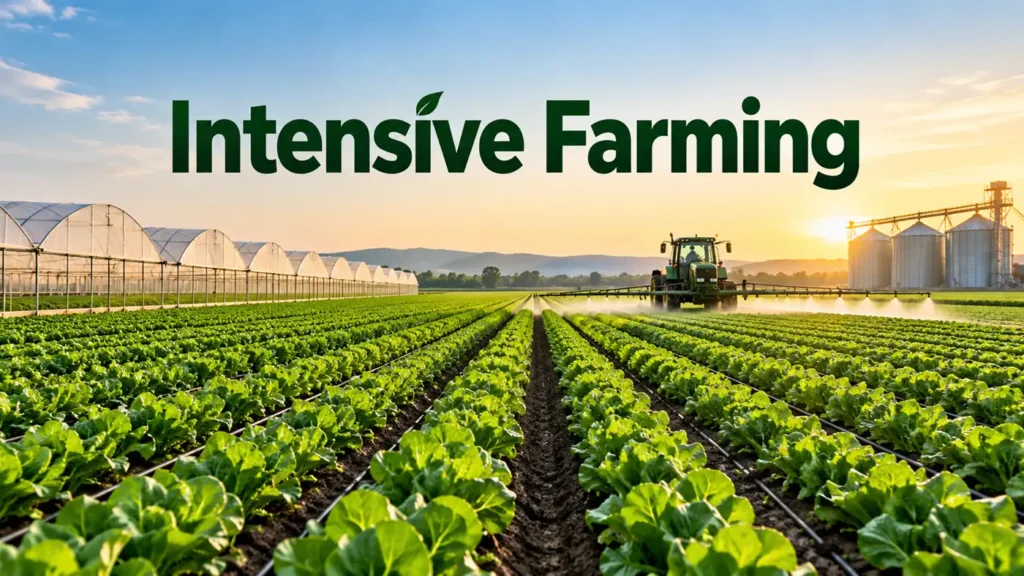
Intensive farming is a method of agriculture that seeks to boost agricultural output from a small amount of land by making use of resources including labor, machinery, irrigation, fertilizers, and more efficient farming techniques, and it is carried out in both crop growing and livestock production according to the particular agricultural system and its aims.
Because of the increasing demand for food and the scarcity of arable land in many areas, intensive farming has now become a major component of modern agriculture. It enables farmers to produce more food per unit of land, but the environmental and economic effects of it will depend on the way the farming system is managed.
What is Intensive Farming?
Intensive farming is a method of agriculture in which relatively high amounts of labor, capital, technology, or other production inputs are used per unit of land to achieve higher agricultural output. According to the Food and Agriculture Organization’s terminology resources, intensive agriculture involves using resources more intensively within a given area to increase productivity.
Unlike extensive farming, which generally uses larger areas of land with comparatively lower inputs per unit area, intensive farming focuses on increasing production from the land already available.
For example, a farmer may use improved seeds, carefully managed irrigation, fertilizers, and machinery to increase wheat production on a particular field. Similarly, intensive livestock farming may involve raising animals in managed housing systems with controlled feeding and veterinary care.
Methods of Intensive Farming
Farmers use different techniques to improve productivity under intensive farming. The methods adopted depend on the crop, climate, soil conditions, available resources, and market demand.
Use of Improved Seeds
High-yielding, disease-resistant crop varieties can help farmers achieve better yields when growing conditions are appropriate. It is important to choose varieties that are adapted to the local soil and climate conditions if cultivation is to be successful.
Mechanization
Farm machinery such as tractors, seed drills, harvesters, and power-operated equipment can enable farmers to carry out their fieldwork efficiently, and mechanization can decrease the amount of time and labor needed for sowing, cultivation, and harvesting.
Irrigation Management
Crops are given water by means of irrigation when there is not enough rainfall. Farmers can make use of methods such as drip and sprinkler irrigation to manage their water more efficiently if the systems are properly designed and kept in good condition.
Fertilizers and Soil Nutrient Management
Both chemical fertilizers and organic sources of nutrients can provide the essential nutrients that plants need and aid in the growth of crops. When soil is tested and the right amount of nutrients is applied, farmers are able to avoid using unnecessary amounts and decrease the likelihood of nutrient losses.
Pest and Disease Management
Farmers can employ integrated pest management, biological control, crop monitoring, and, in necessary cases, approved pesticides in order to deal with pests and diseases. Taking timely action can reduce crop losses and improve the quality of the agricultural produce.
Multiple Cropping and Crop Rotation
Multiple cropping involves growing more than one crop on the same land within a year, where climatic and soil conditions permit. Crop rotation involves growing different crops in sequence to help manage soil fertility, pests and diseases. These practices can improve land productivity, although suitable crop choices and adequate recovery of soil nutrients are essential.
Protected Cultivation
Greenhouses, polyhouses and other protected structures allow farmers to manage growing conditions more closely. These systems can support intensive cultivation of vegetables, flowers and other high-value crops, but they may require substantial investment, energy and technical knowledge.
Intensive Livestock Management
In livestock production, intensive systems may use managed housing, formulated feed, controlled breeding, regular veterinary care and monitoring of animal health. Good ventilation, hygiene, adequate space and appropriate animal welfare practices are important for reducing disease risks and maintaining productivity.
Advantages of Intensive Farming
As long as it is properly planned and managed, intensive farming has a number of advantages.
Higher Production per Unit of Land
Intensive farming can increase its output per hectare by using appropriate crop varieties, managing nutrients, providing irrigation, and applying better farming methods.
Efficient Use of Limited Farmland
This could enable farmers to increase the amount of food they produce on the agricultural land they currently have, thus lessening the need to turn over more natural areas into farmland when productivity gains are achieved in a sustainable way.
Support for Food Supply
Higher agricultural output can contribute to food availability for growing populations and help supply markets with cereals, vegetables, fruits and animal products.
Better Farm Productivity
Mechanization and improved farm management can increase operational efficiency, reduce delays in fieldwork and improve the consistency of agricultural production.
Potential for Higher Farm Income
Intensive farming may generate higher returns per unit of land when additional production and market prices justify the costs of seeds, fertilizers, machinery, irrigation and labor.
Opportunities for Modern Technology Disadvantages
Intensive systems can benefit from precision agriculture, soil testing, automated irrigation, crop monitoring and other technologies that help farmers make informed decisions.
Disadvantages of Intensive Farming
Intensive farming may cause environmental and economic problems, particularly if the inputs are not well managed.
Soil Degradation
Repeated cultivation, excessive tilling, and failure to adequately replace organic matter can lower soil quality. It is possible to help maintain soil health by using suitable crop rotation, cover crops, and conservation practices.
Water Consumption and Pollution
Because of the intensive production of crops, a great deal of irrigation may be necessary. Drawing too much water can exert pressure on local water resources, and runoff from fertilizers and pesticides can lead to the contamination of adjacent water bodies.
Dependence on Agricultural Inputs
Certain intensive farming systems place a great deal of reliance on bought fertilizers, pesticides, fuel, machinery, and improved seeds. If the prices of these inputs go up, then the cost of production and the financial risks facing farmers will also increase.
Loss of Biodiversity
Large areas devoted to a single crop, along with excessive pesticide use and the removal of natural habitats, can reduce biodiversity and affect beneficial insects and other wildlife.
Animal Welfare Concerns
In some intensive livestock systems, there are welfare problems when the animals are kept in overcrowded or inappropriate conditions, and it is necessary to provide them with proper housing, enough space, good ventilation, veterinary care, and careful management in order to ensure their health.
Intensive Farming in India
Intensive farming is relevant to Indian agriculture because farmland, water availability and farm sizes vary considerably across the country. Farmers use different combinations of irrigation, improved seeds, fertilizers, machinery and multiple cropping to increase agricultural productivity.
Rice, wheat, vegetables and other crops may be cultivated intensively in areas with suitable soil, water and market access. In regions where farmers grow more than one crop each year, appropriate crop planning and irrigation management are particularly important.
Intensive farming in India also encounters problems including the depletion of groundwater in certain agricultural areas, an unbalanced use of fertilizers, soil degradation, and increasing input costs. Since these difficulties differ according to location and the type of farming practice, the solutions have to be adjusted to the local conditions.
Farmers can increase their productivity and, at the same time, reduce environmental damage that is avoidable by carrying out soil testing, using efficient irrigation methods, applying integrated pest management, diversifying their crops, and using a balanced application of nutrients.
How Can Intensive Farming Become More Sustainable?
Sustainable intensive farming aims to maintain or improve agricultural productivity while conserving soil, water, biodiversity, and other natural resources.
- Farmers can adopt several practices to support this goal:
- Use soil testing to guide fertilizer application.
- Adopt drip or sprinkler irrigation where appropriate.
- Practice crop rotation and maintain soil organic matter.
- Use integrated pest management in order to cut down on the unnecessary use of pesticides.
- Fertilizers should be applied in accordance with the needs of the crop and with the local recommendations.
- Soil erosion can be reduced by using cover crops and appropriate conservation practices.
- Use precision farming tools to monitor crop conditions and manage inputs.
- Improve livestock housing, hygiene and animal welfare where intensive animal production is practiced.
The most suitable practices depend on local conditions, farm size, available technology and the costs involved.
FAQs about Intensive Farming
Intensive farming is an agricultural system that seeks to increase production per unit of land through the efficient use of labor, capital, technology and other farming inputs. It can improve land productivity, support food supplies and create opportunities for higher farm income.
However, if inputs are used in excess or are not properly managed, they can result in soil degradation, water pollution, a loss of biodiversity, and higher production costs. Farmers can adopt intensive farming systems that are both productive and environmentally sustainable by putting into practice balanced nutrient management, efficient irrigation, crop diversification, and responsible pest control.