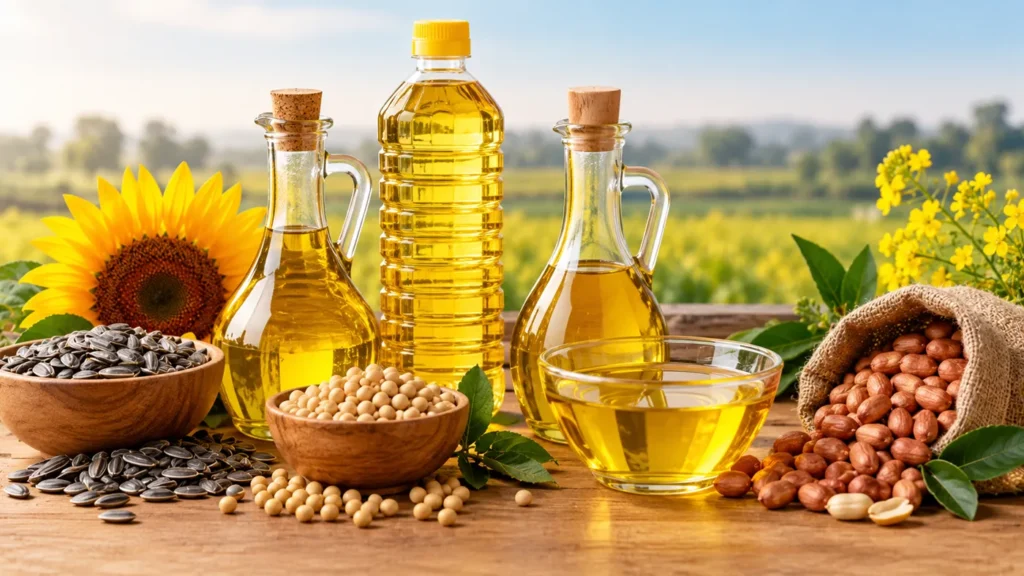
Edible oil is an essential part of the Indian diet and plays an important role in cooking, food processing, and nutrition. From mustard and groundnut oil to soybean, sunflower, rice bran and palm oil, consumers have a wide range of options to choose from. Edible oils provide energy and also help the body absorb fat-soluble vitamins such as vitamins A, D, E and K.
India is one of the world’s major consumers of edible oils. However, domestic oilseed production has historically not been sufficient to meet the country’s growing demand. This makes edible oil production, oilseed farming, imports and government policies important parts of India’s agricultural and food economy.
What is Edible Oil?
Edible oil is a plant or animal-derived fat that is suitable for human consumption. In India, most commonly consumed edible oils are extracted from oilseeds and other plant sources. The oil is separated from the raw material through processes such as mechanical pressing, solvent extraction, and refining.
The source of an oil has an effect on its nutritional content. Different types of oil have different amounts of saturated, monounsaturated, and polyunsaturated fatty acids and some of them also contain natural substances such as vitamin E and other antioxidants.
Major Sources of Edible Oil
Edible oils can be obtained from several crops and plants. Some of the major sources include:
Mustard
Mustard oil is widely consumed in several parts of India, particularly in northern and eastern regions. Mustard is an important rabi oilseed crop and contributes significantly to India’s domestic edible oil supply.
Soybean
Soybean is an important source of vegetable oil as well as protein-rich soybean meal. Soybean cultivation is concentrated in several central and western parts of India. Soybean oil is commonly used for household cooking and food processing.
Groundnut
Groundnut, or peanut, is an important oilseed crop grown mainly in states such as Gujarat, Andhra Pradesh, Tamil Nadu and Karnataka. Groundnut oil is valued for its flavor and cooking properties.
Sunflower
Sunflower oil is obtained from sunflower seeds and is widely used as a cooking oil. The crop can be grown in different parts of India, although production levels vary depending on weather, irrigation and market conditions.
Rice Bran
Rice bran oil is extracted from rice bran, a by-product of rice milling. Because rice is cultivated extensively in India, rice bran provides an additional source of edible oil from the country’s large rice-processing industry.
Palm Oil
Palm oil is obtained from the fruit of oil palm trees. It is one of the world’s most widely produced vegetable oils and is used extensively in food processing. India also imports significant quantities of palm oil to meet domestic demand.
Types of Edible Oil
Edible oils can be classified according to their source and the way they are processed.
Cold Pressed Oils
Cold-pressed oils are produced primarily through mechanical pressing without extensive heating. These oils may retain more of some naturally occurring compounds and often have a distinct flavor and aroma.
Refined Oils
Refined oils are subjected to various processes with the aim of eliminating impurities, unpleasant odours, colours, and other elements. As a result of refining, the oil acquires a more neutral flavour and becomes more stable for use in some cooking and food-processing situations.
Virgin and Extra Virgin Oils
The labels virgin and extra-virgin are especially connected with certain oils, for example olive oil; these oils are made by means of mechanical methods and are assessed according to defined quality standards.
Importance of Edible Oil in the Diet
Fats are an important source of energy and are required for several functions in the human body. Dietary fats also help with the absorption of fat-soluble vitamins.
However, not all fats have the same nutritional profile. A balanced diet generally requires attention to the type and quantity of fat consumed rather than simply eliminating fats altogether. Consumers should therefore consider overall dietary patterns, portion sizes and the nutritional characteristics of different oils.
Edible Oil Production in India
India has a large and diverse oilseed sector. Major oilseed crops include soybean, rapeseed-mustard, groundnut, sunflower, sesame, safflower and niger seed.
Oilseed cultivation provides income to millions of farmers and supports industries involved in processing, refining, packaging and distribution. Improving productivity of domestic oilseeds can help strengthen the country’s edible oil supply chain.
Production can be affected by rainfall, irrigation availability, pest and disease pressure, crop prices, input costs and access to improved agricultural technologies.
Why Does India Import Edible Oil?
India’s demand for edible oil is influenced by population, income levels, changing food habits and the growth of the food-processing industry. Domestic production does not always meet total consumption requirements, so imports form an important part of the country’s edible oil supply.
Palm oil, soybean oil and sunflower oil are among the major edible oils imported into India. Changes in international prices, exchange rates, domestic production and import duties can influence the prices consumers pay.
Reducing excessive dependence on imports is one reason why increasing domestic oilseed production has become an important agricultural objective.
Government Initiatives for Edible Oil Production
The Government of India has introduced programs aimed at increasing domestic production of edible oils and improving oilseed productivity.
One important initiative is the National Mission on Edible Oils-Oilseeds (NMEO-OS). The mission focuses on increasing the production of major oilseed crops, improving productivity and strengthening the oilseed value chain. It also seeks to encourage farmers to adopt better technologies and improve the availability of quality planting material.
A further significant initiative is the National Mission on Edible Oils-Oil Palm (NMEO-OP), aimed at extending oil palm farming to suitable areas and at the same time advancing the related value chain.
Such initiatives are intended to increase domestic availability of edible oils and strengthen the country’s oilseed sector.
Benefits of Domestic Edible Oil Production
Increasing domestic edible oil production can provide several agricultural and economic benefits.
Greater Farmer Income
Improved oilseed productivity and better market opportunities can increase the earning potential of farmers.
Reduced Import Dependence
Higher domestic production can reduce the gap between consumption and domestic availability.
Better Use of Agricultural Resources
Improving productivity allows farmers to obtain greater output from existing cultivated areas.
Employment Generation
Oilseed cultivation, processing, refining, packaging and distribution create employment across the agricultural value chain.
Value Addition
By processing oilseeds locally it is possible to generate extra economic value rather than depending mainly on basic agricultural commodities.
Challenges in the Edible Oil Sector
Although it is important, the edible oil sector in India comes up against a number of difficulties. The productivity of oilseeds is still uneven among different crops and areas. Since many oilseed farmers rely heavily on rainfall, their production is vulnerable to droughts and unpredictable weather.
Small and fragmented landholdings can also make the adoption of modern technologies more difficult. Farmers may face challenges accessing quality seeds, irrigation, machinery, storage, and reliable markets.
A further difficulty is the competition posed by imported oils. Changes in international prices and alterations in import policies can have an effect on domestic prices, impacting both consumers and farmers.
Climate change could lead to new difficulties since it increases the frequency of extreme weather events and has an effect on crop yields.
Future of Edible Oil Production in India
The future of India’s edible oil sector will depend on improving productivity, strengthening oilseed value chains and encouraging sustainable agricultural practices. Better-quality seeds, efficient irrigation, improved farm machinery, scientific pest management and access to agricultural information can contribute to higher productivity.
There is also scope for greater use of modern processing technologies and better storage infrastructure. Reducing post-harvest losses and improving links between farmers, processors and markets can make the overall value chain more efficient.
Promoting a diverse range of suitable oilseed crops can also strengthen domestic production while providing farmers with additional crop options.
FAQs about Edible Oil
Edible oil is an important component of India’s food system and agricultural economy. Mustard, soybean, groundnut, sunflower, rice bran and palm oil all contribute to the country’s edible oil landscape. While domestic oilseed production has significant potential, India continues to rely on imports to meet part of its consumption requirements.
All of these measures increasing the productivity of oilseeds, supporting farmers, improving the processing infrastructure, and strengthening domestic value chains can contribute to making the edible oil sector more resilient. Moreover, consumers can make informed choices by taking into account the nutritional properties and proper way of using different oils as part of a balanced diet.