NMEO-OS: Strengthening India’s Oilseed Sector
India’s oil story is closely connected to its farms, food security and rural economy. From mustard and groundnut to soybean and sunflower, oilseed crops play an important role in both Indian agriculture and everyday diets. However, domestic edible oil production has struggled to keep pace with demand, making higher oilseed productivity and better processing infrastructure increasingly important.
In order to meet this challenge, the Indian Government approved the National Mission on Edible Oils – Oilseeds (NMEO-OS) in October 2024. The mission is aimed at increasing domestic oilseed production, improving productivity and strengthening the whole value chain with the goal of attaining greater self-reliance in edible oils.
What is NMEO-OS?
The National Mission on Edible Oils-Oilseeds (NMEO-OS) is a centrally sponsored scheme designed to increase oilseed production and improve the collection and extraction of edible oil from both primary and secondary sources. The mission will run for seven years, from 2024-25 to 2030-31, with a financial outlay of 10,103 crore. It aims to raise primary oilseed production from 39 million tonnes in 2022-23 to 69.7 million tonnes by 2030-31.
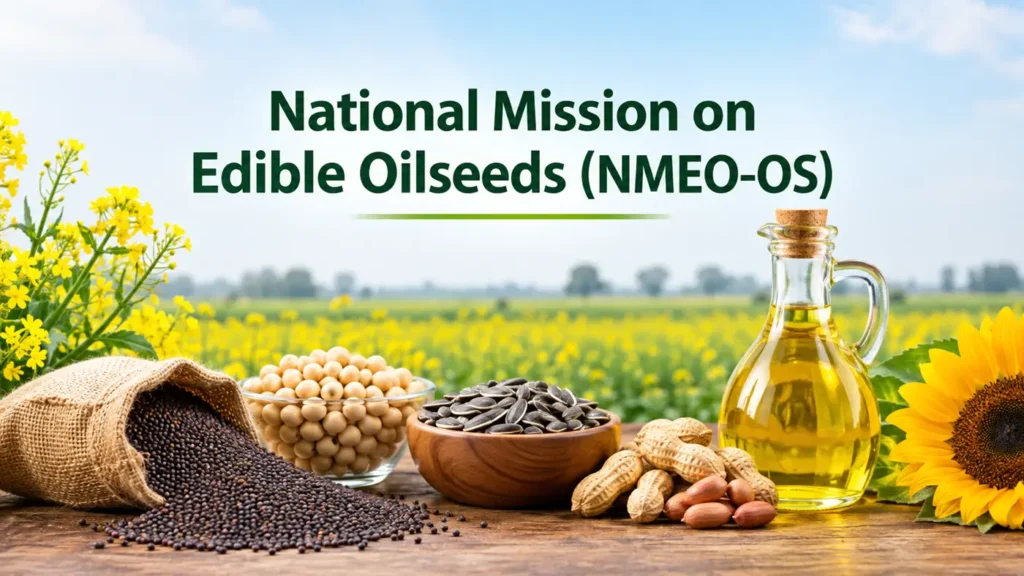
The program covers major oilseeds including rapeseed mustard, groundnut, soybean, sunflower, sesame, safflower, niger, linseed and castor. It also seeks to improve oil recovery from secondary sources such as cottonseed, coconut, rice bran and tree-borne oilseeds.
Key Objectives of NMEO-OS
Increase domestic oilseed production.
A major objective is to substantially increase the production of primary oilseeds by improving crop productivity, expanding cultivation and encouraging better agricultural practices.
Promote High Yielding Varieties
The mission supports access to improved and high-yielding seed varieties. It also strengthens the seed system through breeder seed support, seed hubs and specialized seed storage facilities.
Improve Farmer’s Productivity
Farmers, particularly small and marginal farmers, are supported through demonstrations, training and improved cultivation practices. ICAR, Krishi Vigyan Kendras and state agriculture departments are involved in demonstrations and technology dissemination.
Strengthen the Oilseed Value Chain
Increasing production is only one part of the challenge. NMEO-OS also focuses on post-harvest infrastructure, oil mills, and better extraction efficiency so that more oil can be recovered from available raw materials.
Reduce Dependence on Imported Edible Oils
The objective is to boost domestic production and enhance processing efficiency in order to reinforce India’s domestic supply of edible oil and decrease its dependence on imports.
How Does NMEO-OS Work?
One of the important features of NMEO-OS is its cluster-based approach. More than 600 Value Chain Clusters have been identified or operationalized across the country. These clusters are managed by Value Chain Partners such as Farmer Producer Organizations (FPOs), cooperatives, and other agencies.
In these clusters farmers are able to get high-quality seeds and receive training in proper agricultural techniques, and the method also tries to link cultivation with processing and markets so as to establish a more integrated oilseed value chain.
The government has also highlighted the importance of rice fallow cultivation and intercropping fr expanding oilseed production where suitable.
Major Oilseed Crops Covered
NMEO-OS focuses on a broad range of oilseed crops, including:
Alongside these primary crops, the mission also looks at improving oil extraction from sources such as cottonseed, coconut, rice bran and tree-borne oilseeds.
Benefits of NMEO-OS
Better opportunities for oilseed farmers
Access to improved seeds, demonstrations, training, and better agricultural practices can help farmers improve productivity and strengthen their participation in the oilseed value chain.
Stronger Domestic Edible Oil Supply
Higher domestic oilseed production can contribute to a more secure supply of edible oils and reduce vulnerability to fluctuations in international markets.
Improved Processing and Value Addition
Investment in oil mills and post-harvest infrastructure can improve extraction efficiency and reduce losses, helping generate more value from oilseed production.
Support for Agricultural Innovation
The mission promotes the use of improved varieties, modern cultivation practices, and research-backed technologies. ICAR and agricultural universities are involved in developing location-specific high-yielding varieties and corresponding production practices.
Strengthening Farmer Collectives
The role of FPOs, cooperatives, and other organisations within the supply chain can help farmers to take a more effective part in aggregation, processing and market linkages.
Challenges in Achieving the Mission’s Goals
Dependence on Imports
Since demand for edible oil in India is still very high, achieving the desired level of domestic production will need continuous improvements in both productivity and the amount of land used.
Yield Gaps
Oilseed production rates show a great deal of variation from one area to another, and in order to narrow the gap between actual and potential yields it is necessary to have appropriate varieties, apply inputs at the right time, provide irrigation when needed, and adopt better farming methods.
Weather Risks
Oilseed crops can be affected by drought, excessive rainfall, heat, and other weather-related stresses. Climate variability can therefore affect both production and farm incomes.
Processing Infrastructure
Increasing production without adequate storage, processing and market infrastructure can limit the benefits reaching farmers. Strengthening the entire value chain is therefore essential.
Adoption of Improved Technologies
The success of new varieties and agricultural technologies depends on their availability, affordability, suitability to local conditions and adoption by farmers.
NMEO-OS and India’s Self Reliance in Edible Oils
One can better understand the significance of NMEO-OS when it is seen as part of India’s wider edible oil strategy. The mission goes beyond merely increasing oilseed production; it aims at linking together seeds, farmers, technology, processing, markets and consumers in a more robust domestic system. Recent government data show that India’s oilseed production increased from 396.69 lakh tonnes in 2023-24 to 429.89 lakh tonnes in 2024-25, while the area under oilseed cultivation increased from 301.92 lakh hectares to 304.40 lakh hectares during the same period.
These figures provide an early indication of movement in the sector, although the mission’s ultimate targets extend to 2030-31
FAQs about NMEO-OS
India’s edible oil challenge cannot be solved by increasing cultivation alone. It requires stronger seeds, better farming practices, efficient processing, reliable market linkages and greater value creation within the domestic agricultural system.
The National Mission on edible oils- oilseeds (NMEO-OS) brings these elements together through a long-term strategy focused on production, productivity and the oilseed value chain. With its 10,103 crore outlay and 2030-31 production target, the mission represents a significant effort to strengthen India’s oilseed sector and move toward greater self-reliance in edible oils.
However, the true test of its success will finally be the extent to which better technologies, infrastructure and market opportunities result in increased productivity and in sustainable benefits for farmers.