Commercial Agriculture
‘Every meal you eat connects you to a farmer.’
We have often heard that agriculture is at the heart of our daily lives, but how often do we actually stop to think about the journey behind the food on our plate? From the crops grown in the fields to the products that reach the markets and then the consumers. Farming plays an integral role in our lives.
As agriculture continues to evolve, farming is no longer limited to producing food for personal consumption. Increasing demand in the market for crops and other agricultural products has encouraged farmers to produce crops at a larger scale for a larger population. This approach is known as commercial farming.
But what exactly is commercial farming? How does it work? What are its benefits, and how can it be profitable in India?
What is Commercial Farming?
Commercial farming refers to the cultivation of crops or rearing of livestock aimed primarily for sale in the market rather than for the farmer’s own consumption. The scale and the methods used can vary depending on the crop, available resources, market demand, climate, and location.
Unlike subsistence farming, where agricultural production is largely intended to meet the needs of the farmer and their household. Commercial farming is closely connected to market demand.
Commercial farming can involve the use of modern agricultural technologies, improved quality of seeds, machinery usage, irrigation systems, crop protection method usage, and organized supply chains. However, commercial farming does not necessarily mean that every farm would be bigger and a huge scale of machinery and utilities would be required; the approach can differ considerably depending on the agricultural enterprise, its set of goals, and profitability.
Types of Commercial Farming
Commercial farming can take up several forms depending on what is produced, how it is to be produced, and how the agricultural enterprise is being managed. You can find some common examples below:
Commercial Crop Farming
Growing crops such as wheat, rice, cotton, sugarcane, fruits and vegetables primarily for sale.
Plantation Farming
Large-scale cultivation of crops such as tea, coffee, rubber, and certain spices.
Horticultural Farming
Commercial production of fruits, vegetables, flowers and other high-value horticultural crops.
Commercial Livestock Farming
Rearing animals such as cattle, goats, sheep or poultry for dairy products such as milk, meat and eggs.
Benefits of Commercial Farming
Better Use of Technology
Commercial agricultural operations may adopt technologies such as mechanized equipment, improved irrigation systems, quality farming tools and modern crop management practices. These technologies can improve efficiency and resource utilization.
Higher Income Potential
Commercial farming allows farmers to produce according to market demand and sell their agricultural products for revenue. Choosing suitable crops, improving productivity, and accessing better markets can create opportunities for higher returns. Commercial agriculture may adopt different technologies such as mechanized equipment, improved irrigation systems, precision farming tools, machinery, and newer modern crop management practices. The Indian Council of Agricultural Research also points to technology adoption, improved crop varieties, and efficient, eco-friendly production practices as important areas of modern Indian agriculture.
Value Addition
Farmers and agricultural businesses can increase the commercial value of their produce through processing, packaging and transportation. For example: agricultural produce can be processed into products with longer shelf lives.
Access to Wider Markets
Commercial products can connect farmers with organized markets, retailers, processors and other buyers. Stronger market linkages can provide opportunities beyond local scales.
Also read: What is Mushroom Farming? Meaning, Types, Benefits and Challenges
Is Commercial Farming Actually Profitable in India?
Commercial farming can be profitable in India, but profit isn’t guaranteed. It depends on several factors, economic and promotional, such as production costs, yield, market prices, availability of irrigation, access to technology, the choice of crop, post-harvest management, and market linkages.
Farmers who understand market demands and are able to control their input costs will be in a better position to achieve sustainable returns. Moreover, value addition and having direct access to markets can also enhance the economics of agricultural production; for instance, ICAR has recorded cases in which processing the agricultural produce before selling it led to considerably better results than selling the raw produce.
Factors that influence crop profitability:
- Crop selection
- Land and input costs
- Irrigation facility
- Labor and machinery costs
- Market demand
- Storage and transportation
- Post-harvest losses
- Government policies and regulations
- Weather and climate conditions
- Access to technology and agricultural knowledge
Challenges in Commercial Farming
Like every large-scale system, commercial agriculture has its own set of hindrances that hit the growth of the business as well as the farmer.
Weather and Climate Risks
Droughts, floods, extreme temperatures, or unseasonal rains can wipe out months of a farmer’s hard work.
Market Price Fluctuation
Agricultural prices can change because of supply, demand, weather conditions, transportation, and other market factors, which can make it difficult to predict income status.
Social and Ethical Concerns
Large-scale farming is pushing small-scale farmers out of business, which can lead to land ownership disputes and migration.
Need for Technical Knowledge
Commercial farming requires more than just simply producing a crop; farmers may need knowledge about crop selection, soil management, irrigation, pest control management, post-harvest handling, and market requirements.
Commercial Farming and Technology
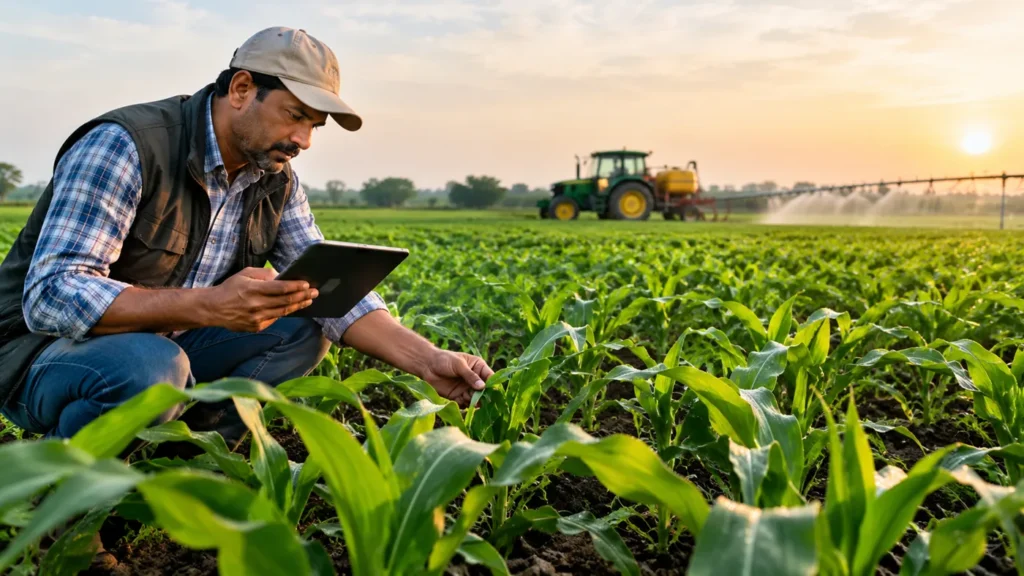
Modern commercial farming is increasingly supported by technology such as precision agriculture, drones, soil sensors, automated irrigation, satellite imagery and farm management software. These tools can help farmers monitor crops, use inputs more efficiently, and make better decisions about irrigation, fertilization, and pest management. As technology becomes more accessible, it is also creating opportunities to improve productivity while also reducing avoidable input costs.
Commercial Farming and Market Demand
Commercial farming, unlike subsistence farming, is greatly affected by market demand and consumer preferences. Farmers generally choose the crops and methods of production according to the expected prices, the demand from food processors, the possibility of export, and the state of the local market. If farmers understand these factors they will be able to plan their production more effectively and decrease the risk of producing crops that have weak market demand.
Role of Supply Chains and Value Addition
A successful commercial farm does not depend only on production. Storage, transportation, processing, packaging and marketing also play an important role in determining farm income. Value addition, like converting fruits into juices, milk into dairy products, or grains into packaged foods, can help farmers and agribusinesses capture more value from agricultural produce and reduce post-harvest losses.
Also read: What is Hydroponic Farming? Meaning, Types, Benefits and Challenges
From the food on our plates to the markets that supply it and the farms it comes from, agriculture plays a crucial role in our lives. Agriculture binds a family sitting in Delhi to the farmer plowing fields in Punjab through food, but the journey from the field to the plates is shaped by an increasingly complex agricultural system.
Commercial farming forms an important element of this system as it links agricultural production with consumer demand and thus provides scope for economic growth. However, in order for these opportunities to result in sustainable returns, farmers have to deal with a number of difficulties including market fluctuations, increasing input costs, climate risks, and the problem of accessing technology and infrastructure.
Commercial farming can help to ensure a more sustainable and economically resilient future for Indian agriculture as a result of making responsible decisions, managing resources, and establishing stronger market linkages.
FAQs about Commercial Farming