What is Subsistence Farming?
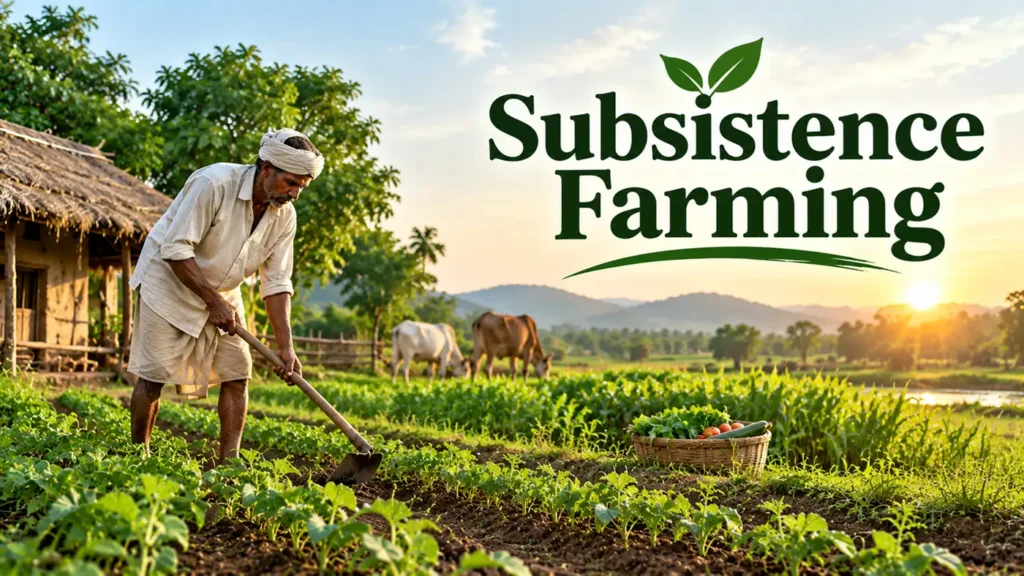
A harvest is not measured by how much it earns, but by how much it provides for the family table. A handful of crops can mean food for a household, livestock can mean security, and a piece of land can become the foundation for a household.
This is the essence of subsistence farming, where farmers primarily produce food for their own needs rather than to generate large profits.
Family labor, local resources, and age-old wisdom where farmers stand as symbols of self-reliance and resilience. Where, farming is not a race for profit, but a daily act of providing for loved ones. In villages everywhere, small fields yield grains, vegetables, and pulses that nourish whole families.
In this form of farming, crops and livestock are primarily raised to meet the farmer’s own needs, rather than for commercial profit.
Types of Subsistence Farming
Intensive Subsistence Farming
Farmers cultivate small plots of land intensively. They rely heavily on family labor to produce as much food as possible.
Primitive Subsistence Farming
Primitive subsistence farming is deeply rooted in tradition, which uses simple tools and nature’s resources. Farmers here grow just enough to feed their families, with little left over for the market.
Shifting Cultivation
Shifting cultivation is also known as slash-and-burn farming, where farmers temporarily cultivate a piece of land and then move to another area when soil fertility declines. The land is then abandoned and allowed to recover naturally.
Nomadic Herding
Rather than planting fields, some communities rely on their herds—cattle, sheep, goats, or camels—for food and survival. They guide their animals from pasture to pasture, always following routes to water and fresh grass.
Benefits of Subsistence Farming
Ensures Household Food Security
The primary purpose of subsistence farming is to feed the farmer’s own family. As a result, growing essential crops locally reduces dependence on buying food from the market.
Makes Use of Family Labour
Subsistence farmers heavily rely on family members for sowing, weeding, harvesting, and taking care of livestock, keeping productive work within the family, thus reducing dependence on hired labor.
Preserves Traditional Farming Knowledge
Subsistence farming carries generations of knowledge about local crops, seasons, soil, and natural farming practices, which helps preserve and utilize the indigenous agricultural traditional values and practices.
Reduces Dependence on Markets
Because most of what they grow ends up on their own tables, subsistence farmers are shielded from the ups and downs of market prices for everyday food.
Encourages Crop Diversity
Farmers grow several crops instead of relying on just a single commercial crop. As a result, this provides a more varied diet and helps spread the risks of losing an entire harvest.
Can Have a Lower Input Requirement?
Small-scale subsistence farms may use locally available seeds, manure, family labor, and traditional tools, reducing the need for expensive external inputs.
Challenges Faced by Subsistence Farming
Low Productivity
Limited access to modern machinery, quality seeds, fertilizers, and technology can keep yields relatively low, making it harder to produce enough food or generate surplus income.
Heavy Dependence on Weather
Rainfall, temperature, and seasonal patterns can directly determine the success of a harvest. Therefore, droughts, floods, and unseasonal rainfall can threaten a family’s food supply.
Limited Access to Irrigation
Many small farmers depend on rainfall because they lack reliable irrigation facilities. This makes cultivation more uncertain, particularly in areas with irregular rainfall.
Lack of Financial Resources
Limited access to affordable credit and agricultural investments can make it difficult for farmers to purchase equipment, improve infrastructure, or adopt better farming techniques.
Small Landholdings
Subsistence farmers often work on small and fragmented plots, leaving little room for expansion or large-scale production.
Limited Market Supply
Because most of the harvest is consumed by the household, there may be very little left to sell. This limits cash income and can make it harder for families to meet expenses beyond food.
Also Read: What are the Difference Between Contour Farming and Terrace Farming?
Profitability in Subsistence Farming
The purpose of subsistence farming is not primarily driven by profit; its main goal is to produce enough food for the farmer’s household. This results in much of the harvest being consumed rather than sold, and direct cash income is often limited.
Subsistence farming still brings economic value by cutting down on food bills. When there is extra to spare, farmers can sell or trade it in local markets, adding a little more to the family’s income.
With better machinery, improved seeds, storage facilities, technology, and market access, subsistence farmers can increase productivity and move towards a more market-oriented model. While profitability may not be its original purpose, improving productivity can still make subsistence farming financially more productive.
FAQs about Subsistence Farming
Subsistence farming faces challenges like limited resources and low productivity, which show why these farmers need modern technology, resources, finance, and tools.
Ultimately, subsistence farming reminds us that agriculture is not always about producing for a market; it can simply be about producing enough to sustain a family.
From soil to supper, every harvest tells us a story of survival, resilience, and the bond between people and the land.