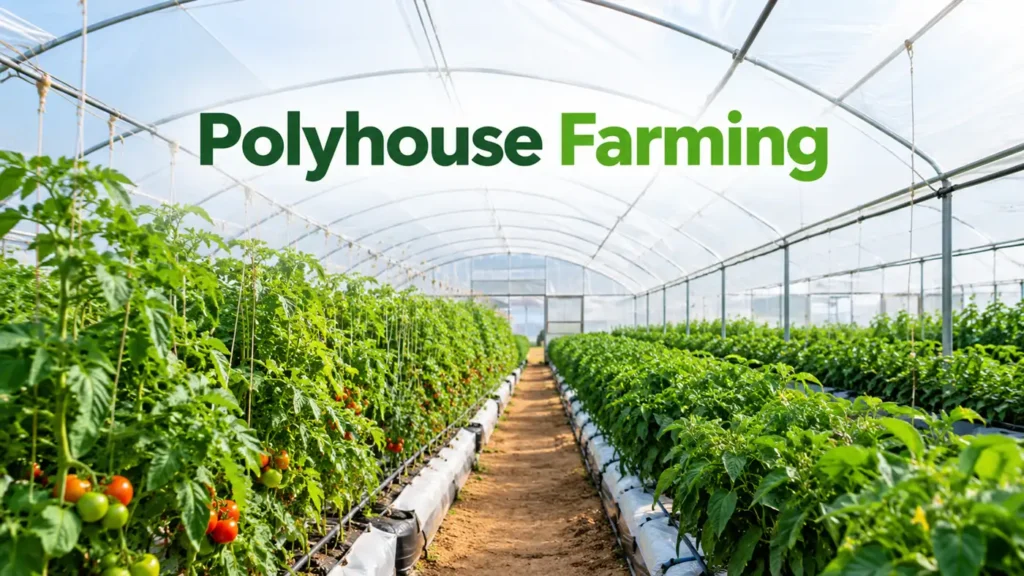
Polyhouse farming is a modern method of agriculture in which crops are grown within a protected building covered with transparent or translucent polyethylene film. The building serves to control growing conditions and guards the crops against some adverse weather conditions, pests, and other environmental factors.
As the demand for high-quality vegetables, fruits, flowers, and other horticultural products has increased, polyhouse farming has come to be seen as a way of improving agricultural productivity. It can help farmers extend the growing season, grow high-value crops, and make more efficient use of water and other inputs, provided that the structure is well designed and operated.
In India, polyhouse farming is particularly relevant to horticulture, where weather fluctuations, water availability, and crop quality can influence farm income.
What is Polyhouse Farming?
Polyhouse farming is a form of protected cultivation in which crops are grown inside a structure covered with polyethylene film, commonly known as poly film. The covering allows sunlight to enter while helping modify the temperature, humidity, and other environmental conditions around the crops.
Polyhouse cultivation differs from open-field farming in that it gives farmers more control over the conditions in which the crop grows. The structure may have ventilation systems, shade nets, drip irrigation, foggers, and other equipment depending on its design in order to regulate temperature and moisture.
Polyhouse farming is commonly used for growing tomatoes, capsicum, cucumbers, leafy vegetables, flowers, seedlings, and other horticultural crops.
However, a polyhouse does not automatically maintain ideal growing conditions. Its effectiveness depends on the local climate, structure design, ventilation, irrigation practices, and the crop being cultivated.
Types of Polyhouses
Polyhouses may be classified on the basis of the systems used for environmental control, the materials used in their construction, and their structural designs.
Naturally Ventilated Polyhouse
To promote airflow, a naturally ventilated polyhouse makes use of any side vents, roof vents, and openings that are available. Instead, it typically depends on natural air movement and not on a fully automated climate-control system.
This type is often more affordable to establish than a highly climate-controlled structure and may be suitable for many horticultural crops in regions with appropriate climatic conditions.
Environmentally Controlled Polyhouse
An environmentally controlled polyhouse uses equipment such as exhaust fans, cooling pads, sensors, and automated controls to regulate growing conditions more precisely.
It can provide greater control over temperature and humidity, but construction, electricity consumption, maintenance, and equipment costs are generally higher.
Low Cost Polyhouse
A low-cost polyhouse makes use of fairly simple construction materials and involves basic arrangements for environmental management. It could be appropriate for small-scale nurseries, for growing crops seasonally, and for farmers who want to start off with protected cultivation but can only make a limited investment.
The durability and performance are determined by the materials used, the local weather conditions, and the amount of maintenance carried out.
Medium and High Tech Polyhouses
Medium and high-tech polyhouses can have stronger structural frames, better ventilation, automated irrigation systems, fertigation systems, and more advanced climate-control equipment.
The level of technology required depends on the crop, climate, expected returns, and available resources.
How Does Polyhouse Farming Work?
Polyhouse farming works by creating a protected growing environment in which farmers can manage crop requirements more effectively.
The process generally involves the following steps:
- Structure Construction: A suitable frame is erected and covered with polyethylene film to protect the growing area.
- Land and Soil Preparation: The growing beds are prepared, and the soil is assessed for fertility, drainage, and other important characteristics.
- Crop Selection: Farmers choose crops according to local climate, market demand, production costs, and the structure’s capabilities.
- Planting: Seeds or healthy seedlings are planted at suitable spacing.
- Irrigation: Irrigation and nutrient management involve providing water and nutrients in accordance with crop needs, usually by means of drip irrigation and fertigation.
- Environment: For environmental management, ventilation, shading, and other systems are employed in order to control temperature, humidity, and light.
- Monitoring of Crops: The monitoring of crops is done on a regular basis, and then appropriate preventive and control measures are taken.
- Harvesting and Marketing: Produce is harvested at the appropriate stage and handled carefully to maintain quality.
Proper monitoring is essential because excessive heat, high humidity, or poor ventilation can damage crops even inside a protected structure.
Crops Suitable for Polyhouse Farming
Several horticultural crops can be cultivated in polyhouses, although the most suitable choices depend on climate, market demand, and the type of structure.
Vegetables
Tomatoes, capsicum, cucumbers, chilies, and some leafy vegetables are usually grown under protected conditions and might gain from better environmental management as well as protection against a number of adverse weather conditions.
Flowers
Flowers such as roses, gerberas, carnations and other ornamental varieties can be cultivated in polyhouses. Protected cultivation can help farmers manage flower quality, production timing and market requirements.
Fruits
Certain small fruits, including strawberries, may be grown under protected cultivation in suitable climates and production systems. The choice of crop depends on temperature requirements, growing media and market opportunities.
Nursery Plants and Seedlings
Polyhouses can be used to raise vegetable seedlings, ornamental plants and other nursery stock. Protected conditions can help improve seedling establishment when moisture, ventilation and temperature are properly managed.
High Value Horticultural Crops
Farmers may also cultivate selected herbs, specialty vegetables and other high-value crops according to local demand. Before choosing a crop, they should assess production costs, expected yields, buyer requirements, and market access.
Advantages of Polyhouse Farming
Provided that it is well planned and well managed, polyhouse farming has a number of possible advantages.
Protection From Adverse Weather
It can lessen the effect of various weather conditions, such as heavy rain, wind, and some changes in temperature. The extent of the protection will vary according to the design and strength of the structure.
Better Environmental Management
Farmers have the ability to control ventilation, irrigation, shading, and, in the case of more advanced systems, temperature and humidity. This in turn helps to produce conditions that are more appropriate for the crops they have chosen.
Potential for Higher Yields
If the crops’ needs are satisfied, protected cultivation can give a higher productivity per unit of land than some open-field systems. The real outcomes will vary according to the type of crop, the climate, the way it is managed, and the level of investment.
Improved Produce Quality
Controlled growing conditions may help reduce certain weather-related defects and improve the appearance and uniformity of horticultural produce.
More Efficient Water Use
Drip irrigation is able to supply water close to the plant roots and thus reduces some of the losses that occur with conventional irrigation methods; yet the amount of water saved will depend on the design of the system, the scheduling, and the maintenance.
Extended Growing Seasons
Whether or not farmers can grow certain crops outside of their normal open-field season in polyhouses will depend on the local temperatures and the environmental-control features of the structure.
Better Opportunities for High Value Crops
Protected cultivation allows premium vegetables, flowers, and seedlings to be grown for specialized markets and may thus lead to higher revenues if demand and prices are favorable.
Disadvantages of Polyhouse Farming
Polyhouse farming also presents several challenges.
High Initial Investment
Because of the size, place, design, and technology involved, the initial outlay required for building materials, polyethylene sheets, irrigation equipment, and environmental-control systems can be substantial.
Maintenance Requirements
The covering will probably need to be replaced from time to time, and the structural parts, the irrigation lines, the filters, and all the other equipment will have to be inspected and maintained.
Temperature and Humidity Management
Polyhouses tend to get very hot when the weather is warm; high humidity together with poor airflow can also lead to some fungal diseases. It is important to have proper ventilation and to manage the environment.
Dependence on Technical Knowledge
Farmers should understand matters relating to crop nutrition, the scheduling of irrigation, pest control, and the way in which the structure operates. Poor management may result in serious crop losses.
Pest and Disease Risks
Protected structures can limit the entry of some pests, but they do not eliminate pest or disease problems. In fact, certain pests and pathogens can spread quickly when conditions inside the structure favor them.
Structural Damage
A polyhouse can be damaged by strong winds, storms, and heavy rain. It is necessary for the structure to be designed with the local weather conditions in mind and to be properly maintained.
Polyhouse Farming Cost in India
The amount it costs to set up a polyhouse in India varies according to the size of the polyhouse, the materials used in its construction, the ventilation system, the irrigation equipment, and the degree of environmental control.
A polyhouse that is fully climate-controlled is generally more expensive than one that is naturally ventilated; in addition, there are extra costs involving land preparation, seedlings, fertilizers, crop protection, labor, electricity, packaging, and transportation.
There is no single cost that applies to every farm. Farmers should obtain current quotations from authorized or experienced suppliers and prepare a crop-specific financial plan before investing.
Factors Affecting Poyhouse Farming Cost
- Size of the Structure: Larger projects may have different per-square-meter construction costs.
- Construction Materials: The frame, polyethylene film, and other components influence the overall price.
- Technology: Automated irrigation, fertigation, cooling pads, fans, and sensors increase investment costs.
- Crop Selection: Different crops require different planting materials, support systems, and growing conditions.
- Location: Transport, labor, site preparation and local weather requirements affect expenses.
- Operating Costs: Water, electricity, fertilizers, crop protection and maintenance contribute to recurring expenditure.
Government Subsidies for Polyhouse Farming
In India, eligible farmers may be able to access financial assistance for protected cultivation through applicable central or state horticulture programs. Assistance, eligibility requirements, approved structures and subsidy rates can vary by scheme, state and beneficiary category.
Farmers ought to go to their state’s horticulture department or to the appropriate district horticulture office in order to get the current guidelines; they must check if approval is needed before carrying out the construction and also verify that the proposed structure and supplier comply with the program’s requirements.
A subsidy should not be assumed to be guaranteed until eligibility and approval have been confirmed.