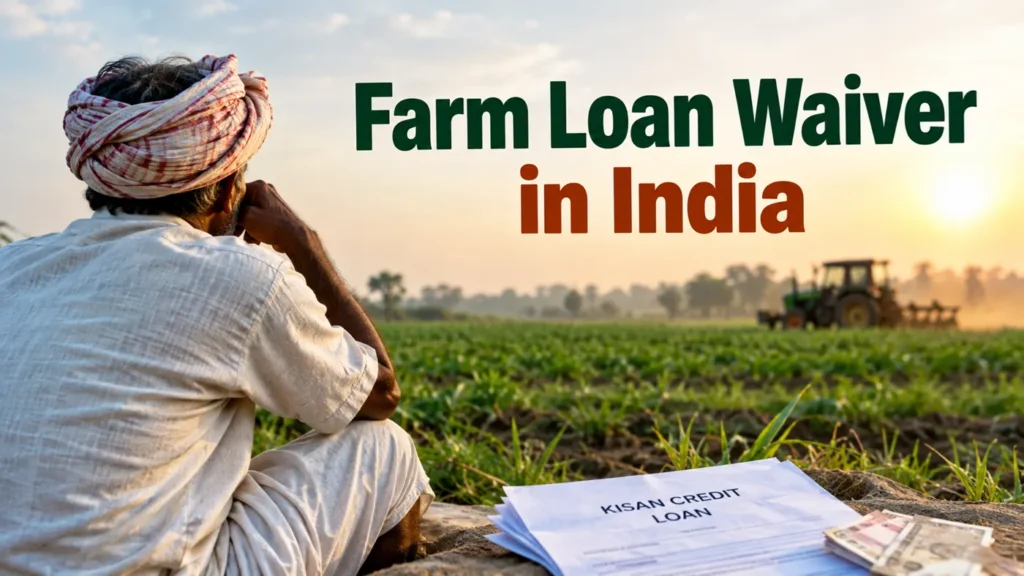
A farmer does not just face a bad season when his harvest fails and may end up with debt carrying over to the next season. Increasing input costs, unpredictable weather, crop losses, and fluctuating market prices make repaying agricultural loans difficult. This is why farm loan waivers have entered the policy debate in India.
A farm loan waiver is a government initiative that cancels part or all of eligible agricultural borrowers’ outstanding loans, based on specific scheme conditions. State governments implement these waivers at different times, typically targeting specific farmer groups and loan types.
What is a Farm Loan Waiver?
A farm loan waiver means the government takes responsibility for repaying eligible agricultural debt owed by farmers to participating lending institutions. Depending on the scheme, the waiver may cover the entire eligible loan or only a specified amount.
Loan waivers are not the same as ordinary agricultural credit support. For example, the Kisan Credit Card (KCC) scheme is intended to give eligible farmers timely and affordable credit, with interest concessions supported by the government. Such as the scheme in Maharashtra in 2019 which offered waivers for eligible crops and restructured crop loans amounting to ₹2 lakh, and Telangana’s 2024 scheme which included eligible crop loans up to ₹2 lakh.
In simpler terms: Agricultural credit helps farmers borrow and invest; a loan waiver provides relief when eligible debt becomes difficult to repay.
Why Are Farm Loan Waivers Introduced?
Farmers can face financial stress when several risks occur at the same time. These may include:
- Crop failure caused by drought, floods, pests or extreme weather.
- Rising costs of seeds, fertilizers, labor, fuel and machinery
- Low or unstable market prices
- Damage to stored or harvested produce
- Difficulties in accessing timely institutional credit
- Accumulation of debt after repeated poor agricultural seasons
In such circumstances, governments may introduce targeted debt-relief programs for eligible borrowers.
Also read: What is Agricultural Policy?
Benefits of Farm Loan Waivers
1. Immediate Debt Relief
The greatest advantage is that eligible unpaid debt will either be reduced or eliminated, giving farmers some much-needed financial relief at once.
2. Helps Farmers Recover After Crop Losses
Even if the money was borrowed with productive agricultural purposes in mind, farmers who suffer heavy losses may find it difficult to repay the debt. Debt relief can assist eligible farmers in recovering from such shocks.
3. Reduces Repayment Pressure
A waiver will lessen the pressure caused by overdue agricultural loans and enable farmers to use their available income for household and farming expenses.
4. Support Fresh Agricultural Investment
After the eligible debt has been cleared, farmers might find that they have more capacity to buy inputs or to invest in the next agricultural cycle, though the real impact will depend on their access to new credit and on the profitability of their farms.
5. Provides Targeted Support During Agricultural Distress
Clear schemes can be arranged so as to provide relief to particular groups of borrowers who are in certain financial situations rather than giving the same treatment to all agricultural borrowers.
Challenges of Farm Loan Waivers
While loan waivers can offer immediate relief, they also give rise to wider financial and institutional questions.
1.Fiscal Pressure on Government
A large-scale waiver involves a great deal of public spending. The cost must eventually be met within the government’s finances and in light of other development priorities.
2.Eligibility and Implementation Issues
It can be complicated to work out which loans, borrowers, and lending institutions are eligible. Problems may also arise during implementation because of the differences between eligible and ineligible borrowers.
3.Limited Reach
Farm loan waivers usually extend only to loans that satisfy the conditions set out in a given scheme, and farmers who rely greatly on informal borrowing will not get similar relief.
4.Credit Discipline Concerns
The constant expectation of future loan waivers can lead to worries regarding borrowers’ repayment behaviour and the operation of agricultural credit markets; this is one of the reasons why loan-waiver schemes are usually mentioned in connection with more extensive agricultural credit reforms.
5.Not Addressing the Fundamental Causes of Farm Distress
Debt cancellation can address existing debt, but it does not automatically solve problems such as low farm profitability, inadequate irrigation, market volatility, high input costs, or crop losses.
Farm Loan Waiver vs Agricultural Credit Support
These two ideas are often discussed together but serve different purposes.
|
FARM LOAN WAIVER |
AGRICULTURAL CREDIT SUPPORT |
|
Provides relief from eligible existing debt. |
Facilitates access to new credit. |
|
Usually introduced under a specific government scheme. |
Operates through established agricultural lending systems. |
|
Primarily addresses repayment stress. |
Supports farming and investment activities. |
|
Can be one time or scheme specific. |
Can be accessed repeatedly subject to eligibility and repayment. |
|
Does not necessarily address farm profitability. |
Can support productive agricultural activity. |
The Kisan Credit Card scheme, is intended to provide adequate and timely credit for agricultural operations, while loan-waiver schemes focus on specified outstanding debt.
Examples of Farm Loan Waivers in India
Farm loan waivers are largely implemented through specific government schemes rather than one permanent nationwide waiver program.
In 2024, Telangana announced a crop-loan waiver of up to ₹2 lakh for eligible short-term crop loans obtained from scheduled commercial banks, regional rural banks and district cooperative banks. The state government subsequently stated that ₹31,000 crore of farm loans had been waived under the program.
In Maharashtra, the Mahatma Jyotirao Phule Shetkari Karjmukti Yojana covered eligible outstanding crop and restructured crop loans up to ₹2 lakh. The state reports that ₹20,497 crore in benefits were provided to 32.37 lakh farmers under the scheme.
These examples also demonstrate why the details of a loan waiver loan type, eligibility date, maximum amount, and participating institutions matter when assessing its impact.
What Can Make Farm Loan Relief More Sustainable?
Loan waivers deal with debt that already exists, but in order to achieve long-term agricultural resilience, it is necessary to take steps that reduce the likelihood of severe debt build-up from the start. Such measures can include:
- Better access to affordable institutional credit
- Crop insurance and effective risk-management systems
- Irrigation and water-management infrastructure
- Improved storage and post-harvest facilities
- Better market access and price discovery
- Investment in agricultural technology and productivity
- Diversification into suitable crops and allied activities
A combination of credit access, risk protection, productive investment and stronger agricultural markets can therefore complement debt-relief measures.
FAQss about Farm Loan Waivers
Farm loan waivers in India lie at the junction of agricultural difficulty, rural credit and public finance; for a farmer who is eligible and suffering from heavy debt, such a waiver can provide substantial immediate relief and an opportunity to begin the next farming cycle.
However, canceling existing debt does not by itself eliminate the risks that created the debt. The longer-term question is how farmers can achieve more stable incomes while having access to affordable credit and protection against agricultural shocks.
A loan waiver can clear yesterday’s debt, but sustainable farming needs a system that makes tomorrow’s income more secure.