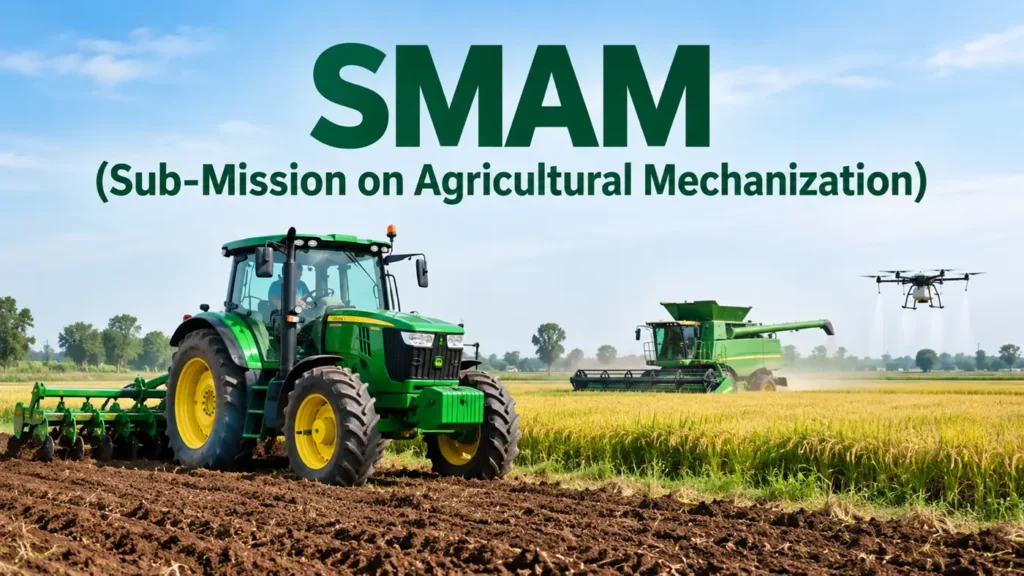
Sub-Mission on Agricultural Mechanization (SMAM)
Agricultural mechanization plays an important role in improving farm productivity, reducing manual labor, and supporting timely agricultural operations. However, purchasing modern agricultural machinery can be expensive, particularly for small and marginal farmers. To address this challenge and improve access to agricultural technology, the Government of India implements the Sub-Mission on Agricultural Mechanization (SMAM).
The objective of the scheme is to increase access to farm machinery, promote efficient methods of agriculture, and encourage the uptake of modern technologies in various parts of the country; it is carried out by the State Governments and is included within the Rashtriya Krishi Vikas Yojana (RKVY).
Objectives Of SMAM
The Sub-Mission on Agricultural Mechanization focuses on making agricultural machinery accessible to a wider section of the farming community. Its main objectives include:
Improving Access to Machinery
Extending the benefits of farm mechanization to small and marginal farmers and regions with limited availability of farm power.
Reducing the Cost of Ownership
Encouraging shared access to machinery through Custom Hiring Centers, particularly where purchasing expensive equipment individually is not practical.
Promoting Modern Agricultural Technology
Supporting the adoption of appropriate machinery for crop production, post-harvest operations, and crop residue management.
Building Awareness and Skills
Conducting demonstrations, training programs, and capacity-building activities to help farmers understand and use agricultural equipment effectively.
Ensuring Equipment Quality
Supporting the testing and certification of agricultural machinery through designated testing centers.
Key Components Of SMAM
Financial Assistance for Agricultural Machinery
SMAM gives financial help to farmers who are eligible to buy agricultural machinery and equipment for their own use. The assistance enables farmers to obtain the equipment needed for different agricultural operations without having to pay the whole of the eligible amount themselves.
The level of assistance and the maximum amount of subsidy vary according to the type of machinery, the applicable cost norms, and the category of the beneficiary. According to the framework set out in the scheme, assistance has covered 40 percent of the prescribed cost of the machine for general beneficiaries and 50 percent for certain categories, such as SC/ST farmers, small and marginal farmers, and those who are beneficiaries in the North-Eastern states. Farmers should refer to the relevant guidelines before making a purchase.
Custom Hiring Centres
Custom Hiring Centers allow farmers to rent agricultural machinery and equipment according to their requirements. These centers are particularly useful for farmers who cannot afford to purchase costly machines or do not need them throughout the year.
By allowing machinery to be hired rather than owned, CHCs can help lessen the financial burden on individuals who wish to own such machinery and make mechanized farming available to smaller farms.
Farm Machinery Banks
The scheme also provides for the setting up of Farm Machinery Banks in eligible areas, since these facilities increase the availability of agricultural equipment to farmers who would otherwise have limited access to modern machinery.
Farm Machinery Banks can be especially valuable in areas where individual ownership is difficult because of high equipment costs or small landholdings.
High-Tech Hubs and Modern Equipment
SMAM supports access to advanced agricultural machinery through initiatives such as high-tech equipment hubs. These facilities can help farmers access specialized or expensive machines that may not be economically practical to own individually.
The scheme also supports the promotion of agricultural technologies, including Kisan drones for agricultural purposes, through eligible assistance and demonstration activities.
Training, Demonstrations and Equipment Testing
Access to machinery alone is not sufficient; farmers also need to understand how to operate it safely and efficiently. SMAM therefore promotes demonstrations, training and capacity building.
Testing and certification activities help assess agricultural machinery against relevant performance and quality requirements. Together, these measures encourage informed equipment selection and more effective use of agricultural technology.
Benefits of SMAM for Farmers
The Sub-Mission on Agricultural Mechanization can offer several benefits to the farming community:
Lower Financial Barriers
Eligible financial assistance can reduce the initial cost of purchasing agricultural machinery.
Timely Farm Operations
Access to suitable equipment can help farmers complete time-sensitive activities such as sowing, cultivation, and harvesting.
Reduced Physical Drudgery
Mechanized operations can reduce the amount of strenuous manual work involved in farming.
Better Access for Small Farmers
Instead of owning them individually, people can make use of rental services and shared machinery agreements.
Improving Post-Harvest Operations
Equipment that is suitable can be used for crop handling, processing, and other operations after harvesting.
Greater Awareness of Technology
Training and demonstrations help farmers understand the practical applications of modern agricultural equipment.
The actual benefits depend on the machinery available, local agricultural conditions, operating costs, and how effectively the equipment is used.
How to Apply For SMAM
People who are interested in the scheme should first look on the official agricultural mechanization portal and with the appropriate State Agriculture Department to find out about the current application procedures, the eligibility requirements, and the machinery that is available.
The general process is as follows:
- Go to the Official Website: visit the “Agricultural Mechanization DBT portal“.
- Check the Eligibility and the Guidelines: have a look at the guidelines of the relevant scheme, the approved machinery, the subsidy norms, and the instructions specific to the state.
- The Application Process: complete the application by following the registration and application process set out for the relevant financial year.
- Provide the Requested Information: supply the documents and details required by the authorities.
- Carry Out the Verification Procedure: Applicants might have to go through eligibility checks, have their documents verified, take part in selection procedures, and meet other requirements which are specific to each state.
- Keep an Eye on the Application: You can do this by using the official portal or by getting in touch with the appropriate state or district agriculture office.
It should be noted that the application periods, machinery targets, selection procedures and assistance standards may differ from state to state and from financial year to financial year. Approval and payment are governed by the relevant scheme rules. Farmers must check the most recent official guidance before buying equipment or paying a dealer.
Recent Progress Under SMAM
The scheme has facilitated the expansion of agricultural mechanization all over India. A publication by the Ministry of Agriculture and Farmers Welfare from 9 July 2026 states that central aid amounting to ₹9,404.47 crore has been used to distribute about 21.61 lakh agricultural machines to individual farmers between 2014–15 and 2025–26.
The same publication reported support for the establishment of 27,554 Custom Hiring Centers, 646 high-tech hubs and 25,608 Farm Machinery Banks. These figures illustrate the scale of the program’s efforts to improve access to agricultural equipment.
FAQs about SMAM
The Sub-Mission on Agricultural Mechanization is an important government initiative aimed at making modern agricultural machinery more accessible to Indian farmers. Through financial assistance, shared equipment facilities, technology demonstrations, and training, the scheme seeks to address the challenges associated with the high cost of agricultural equipment and unequal access to farm power.
Its effectiveness will depend on proper implementation, on farmers being aware of it, and on suitable machinery being available at the local level. SMAM can help to make agricultural operations more efficient and thus contribute to the long-term development of India’s farming sector by promoting appropriate and affordable mechanization.