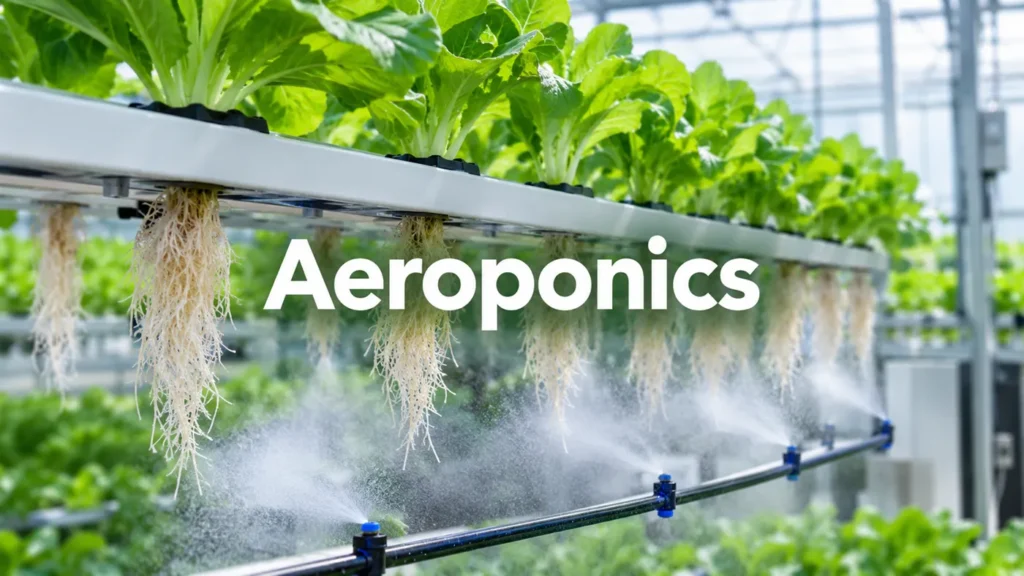
Aeroponics is an innovative method of farming that enables plants to grow without soil by hanging their roots in the air and giving them a mist that is rich in nutrients. This contemporary form of agriculture provides an alternative to conventional farming methods since it uses less water, makes good use of space, and allows crops to be grown in places where there is little fertile soil. Because demand for food is still increasing and environmental problems are having an effect on the productivity of farming, aeroponics is becoming more widely regarded as a promising solution for sustainable food production.
What is Aeroponics?
Aeroponics is a soilless farming technique in which plant roots remain suspended in an enclosed or partially enclosed environment. Instead of absorbing nutrients from soil, the roots receive water and essential minerals through a fine mist delivered by specialized spraying systems.
The system usually includes a growing chamber, plant holders, a nutrient solution, misting nozzles, a water reservoir, and a device for controlling humidity and other environmental conditions. The roots, since they are exposed to air, are able to take in oxygen directly as they absorb the moisture and nutrients needed for growth.
Aeroponics is generally used for growing leafy vegetables, herbs, strawberries, and some other crops. It is likewise useful in research laboratories and in controlled-environment agriculture, where accurate growing conditions can be kept.
How Does Aeroponics Work?
The aeroponic farming process involves several important steps:
For Plant Positioning
The seedlings are put into holders that are specially designed to support the plants and at the same time allow their roots to dangle freely within the growing chamber.
Nutrient Preparation
Essential nutrients, such as nitrogen, phosphorus, potassium, and other minerals needed for healthy plant growth, are mixed with water.
Nutrient Misting
The nutrient solution is sprayed directly onto the exposed roots at regular intervals using a pump and misting nozzles.
Oxygen Absorption
The roots, as they are neither submerged in water nor surrounded by soil, are able to obtain oxygen directly, which in turn promotes root respiration and healthy growth.
Environmental Control
The temperature, humidity, lighting, and misting schedules are all controlled in order to ensure suitable conditions for plant growth.
Harvesting and Maintenance
When the crops have matured, they are harvested. The equipment should be cleaned regularly, and the nutrient solution and misting system should be kept under observation in order to maintain plant health.
Types of Aeroponic Systems
Aeroponic systems can be classified according to how they deliver nutrients to plant roots.
High-Pressure Aeroponics
These systems use specialized pumps and nozzles to produce very fine droplets of nutrient solution. They can deliver nutrients efficiently but require precise maintenance and suitable equipment.
Low-Pressure Aeroponics
The systems make use of relatively simple pumps or spraying arrangements in order to supply the nutrient solution to the roots. While they can be more easily set up on a small scale, the size of the droplets and the way in which they are distributed depend on the design.
Both systems require reliable moisture delivery because exposed roots can dry out quickly if misting stops for an extended period.
Advantages of Aeroponics
Aeroponics offers several benefits that make it an attractive option for modern agriculture.
- Efficient Use of Water: This is achieved by delivering water directly to the plant roots, and in some cases, the nutrient solution that is not used is collected and recycled. As a result, water usage can be considerably less than with many traditional farming methods.
- No Soil Requirement: Plants can be cultivated in locations with poor soil quality or limited agricultural land, including urban environments and indoor growing facilities.
- Efficient Use of Space: Plants can be grown in vertical arrangements, allowing growers to produce crops in relatively small areas.
- Potential for Faster Plant Growth: If sufficient oxygen, nutrients, and environmental control are available, rapid growth can be achieved with appropriate crops. Yet the actual growth rates will vary according to the type of crop and the growing conditions.
- Reduced Soil-Related Problems: Because plants grow without soil, the risk of certain soilborne pests and diseases can be reduced. Nevertheless, waterborne diseases and other forms of contamination can still occur.
- Year-Round Cultivation: By regulating the lighting, temperature, and humidity, indoor aeroponic farms are able to grow crops all year round, which decreases their reliance on seasonal weather.
Challenges of Aeroponic Farming
High Initial Investment
This is required since the pumps, misting equipment, growing chambers, sensors, and environmental control systems all involve a considerable amount of money up front.
Technical Knowledge
If cultivation is to be successful, then it is necessary to have an understanding of nutrient management, plant physiology, equipment maintenance, and environmental conditions.
Reliance on Electricity
Since pumps and the automated systems need a steady supply of power, interruptions in the power supply may stop the misting and lead to the exposed roots drying out.
With Regard to Equipment Maintenance
The misting nozzles may become clogged, and the pumps might fail. It is necessary to carry out regular cleaning and inspections in order to make sure that the nutrients are delivered consistently.
Limited Crop Suitability
Even though aeroponics is capable of growing a number of different types of plants, it is not equally practical or economical to use this method for every crop.
The Running Costs
The costs associated with electricity, replacing equipment, labor, and climate control may lead to higher ongoing expenses, especially in the case of indoor farms.
Applications of Aeroponics in Modern Agriculture
Aeroponics has a number of uses in the areas of food production and in plant research. It allows urban farmers to grow leafy vegetables and herbs in small spaces close to where consumers are. Commercial growers might choose to use aeroponic systems in the case of special crops since the ability to control conditions and the efficient use of land provide economic advantages.
This technique is likewise useful in plant nurseries when it comes to producing healthy roots and for propagating some plants. In scientific research, aeroponics allows researchers to observe root development and to examine how plants react to different nutrients and environmental conditions.
Aeroponics also has potential uses in environments with limited resources since conventional farming is difficult there. Yet its large-scale adoption will depend on the choice of crops, the infrastructure available, the amount of energy present, and the economic viability.
Aeroponics and Sustainable Agriculture
Aeroponics can play a part in achieving sustainable agriculture by improving water-use efficiency, decreasing the need for fertile soil, and enabling food production in urban areas. If it is used together with renewable electricity, efficient lighting, and careful nutrient management, it could help in reducing some of the environmental impacts linked to food production.
Sustainability is determined by the way the system is designed and run. Although indoor farms that are energy-intensive may have a large electricity footprint, the manufacturing and disposal of the equipment can also lead to extra environmental costs. For this reason, farmers have to consider water savings, energy use, crop yields, and operating expenses all at the same time.
Integrating aeroponics with renewable energy and efficient resource management can help improve its long-term environmental performance.
FAQs about Aeroponics
Aeroponics is a promising method of farming without soil since it employs a mist containing nutrients to promote plant growth while making good use of both water and space. The fact that it can function in controlled conditions opens up possibilities for urban agriculture, for carrying out plant research, and for the production of specific crops. Even though high installation costs, the need for technical knowledge, and reliance on electricity are still major difficulties, ongoing improvements in the equipment and in the methods of cultivation could widen its range of applications. Aeroponics can help in the development of innovative and sustainable agricultural systems if careful planning and responsible management of resources are carried out.