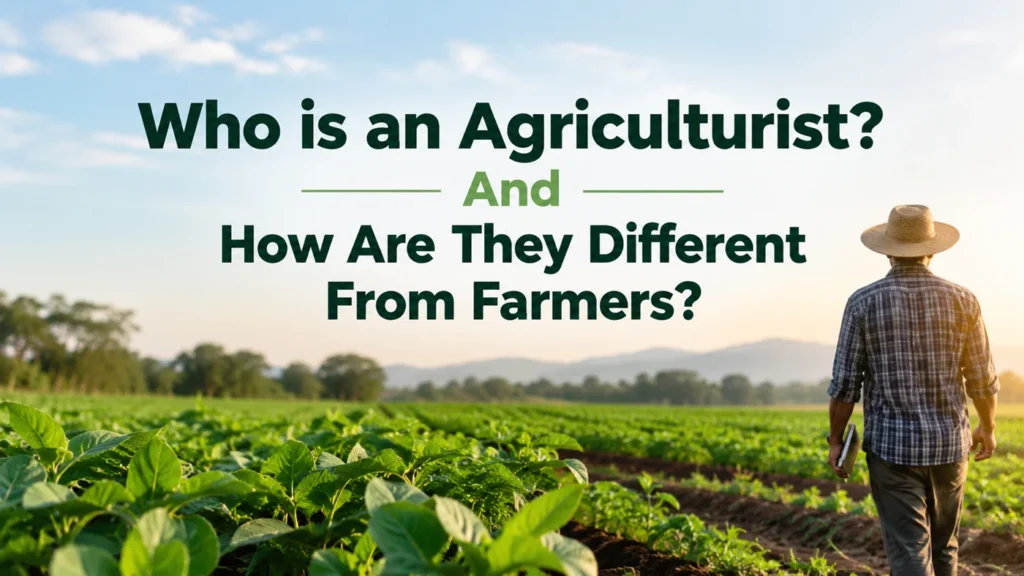
Agriculture is important for food production, economic development, and providing livelihoods for people in rural areas. The agricultural sector consists of individuals who are involved in growing crops, looking after livestock, improving farming methods, and setting up sustainable systems for food production. Two key terms in this area are ‘agriculturist’ and ‘farmer’. While the two terms are often used in the same way, there can be differences in their meanings, responsibilities, and areas of expertise. Knowing the difference between an agriculturist and a farmer helps to clarify the various roles that are present in modern agriculture.
Who is an Agriculturist?
An agriculturist is a person who has specialized knowledge of agriculture and applies it to crop production, soil management, livestock development, agricultural research, or farm improvement. Agriculturists may work directly in agricultural operations or contribute through scientific research, technical advice, planning, and the development of improved farming methods.
Their work may include investigating soil fertility, choosing appropriate crops, managing pests and diseases, improving irrigation systems, and encouraging the adoption of sustainable agricultural practices. Although some agriculturists work as agricultural scientists, consultants, researchers, extension officers, or farm managers, others run their own agricultural businesses.
A person may have received a formal education in agriculture, horticulture, agronomy, soil science, or in one of the related fields. Nevertheless, the term can also be applied more generally to those who are knowledgeable and take an active part in agricultural practices. The precise meaning of the term will vary according to the context in which it is used.
Who is a Farmer?
A farmer is a person who cultivates land, grows crops, raises livestock, or manages agricultural activities to produce food, fiber, and other useful products. Farmers are directly involved in the practical aspects of agricultural production and play an essential role in supplying raw materials to food processing industries and markets.
Their jobs can involve preparing the land, planting seeds, watering the crops, using fertilizers, getting rid of weeds, looking after the livestock, harvesting the crops, and selling the agricultural products. In addition, farmers have to decide what crops to grow, when to plant them, and how to manage their resources in light of the weather conditions, market demand, and the funds available.
Farmers obtain their agricultural knowledge by means of experience, traditional methods, formal education, training, and by interacting with other agricultural professionals. They can run small family farms, large commercial farms, livestock operations, or specialized agricultural businesses.
Difference Between Agriculturists and Farmers
Although agriculturists and farmers contribute to the same sector, their roles may differ in several ways.
- Primary Focus: Agriculturists may focus on agricultural science, technical knowledge, research, planning, and improving production methods. Farmers primarily focus on cultivating crops, raising livestock, and managing day-to-day agricultural operations.
- Education and Expertise: Those who are involved in agriculture may have acquired specialized academic qualifications or might have undergone technical training in the area of agricultural sciences. Farmers can obtain expertise through practical experience, family traditions, formal education, or by combining these methods.
- The Nature of the Work: Agriculturists can carry out experiments, examine soil conditions, suggest different crop varieties, formulate pest-control strategies, or give advice to farming communities. Farmers usually put into practice appropriate agricultural methods and look after production activities, even though they too may carry out experiments and develop their own innovative techniques.
- Workplace: Agriculturists may work on farms, in laboratories, at research institutions, in government departments, or with agricultural companies. Farmers usually work on agricultural land, livestock facilities, orchards, or other production sites.
- The Main Objective: Farmers may wish to enhance agricultural productivity, efficiency, scientific knowledge, and sustainability. Generally, farmers aim to successfully produce crops or livestock while at the same time keeping their operations economically viable.
- Scope of Responsibilities: Agriculturists may work across several farms or agricultural projects by providing technical expertise. Farmers are often responsible for the management and performance of a particular farming operation, although the scale of their work varies.
These differences are general rather than absolute. A person can be both an agriculturist and a farmer, particularly when they combine scientific knowledge with hands-on farming.
Relationship Between Agriculturists and Farmers
Farmers and agriculturists frequently collaborate in order to boost agricultural productivity and deal with the problems involved in food production. The agriculturists can give scientific advice, introduce better crop varieties, examine the condition of the soil, and recommend efficient methods of irrigation or pest control. The farmers then put these recommendations into practice and give feedback on the basis of their experience in the fields.
For instance, an agriculturist could examine the way a certain crop reacts to different fertilizer rates and then suggest an appropriate nutrient-management plan. The farmer could put the plan into practice, keep an eye on the crop’s growth, and evaluate its effectiveness in local conditions.
This partnership aids in narrowing the gap between agricultural research and its practical application. It can furthermore contribute to more effective resource management, less production loss, better crop quality, and more sustainable farming systems.
Importance of Agriculturists in Modern Agriculture
Agriculturists contribute to the development of modern agriculture by applying scientific knowledge and technical expertise to agricultural challenges.
- Improving Crop Productivity: They can determine which crop varieties, methods of planting, and nutrient-management practices might lead to higher yields.
- Promoting Soil Health: Agricultural experts can suggest measures such as carrying out soil testing, using balanced fertilization, implementing crop rotation, and managing organic matter in order to keep the soil fertile.
- In the Management of Pests and Diseases: They assist in the development of integrated pest-management strategies in order to reduce crop damage and promote responsible pesticide use.
- Promoting Sustainable Farming: They advocate techniques that increase resource efficiency, conserve water, protect biodiversity, and reduce environmental impacts.
- Introducing Agricultural Technology: Farmers could back the introduction of precision farming, automated irrigation, remote sensing, and other technologies that enhance agricultural decision-making.
- Giving Technical Advice: By means of agricultural extension services, training, and consultancy, they assist farmers in understanding new techniques and in dealing with changing agricultural conditions.
Importance of Farmers in the Agricultural Sector
Farmers are essential to the functioning of the agricultural economy because they carry out the production activities that supply food and agricultural raw materials.
- Food Production: In the area of food production, farmers cultivate cereals, pulses, vegetables, fruits, and other types of crops in order to ensure food security.
- Livestock Management: A great many farmers keep animals in order to obtain milk, eggs, meat, and other agricultural products.
- Rural Employment: Farming provides a means of livelihood for agricultural workers, transport providers, traders, and all other people linked to the food supply chain.
- Economic Contribution: The production of agricultural products supplies the textile, food processing, and bio-based manufacturing industries with their raw materials.
- Conservation of Traditional Knowledge: The conservation of traditional knowledge involves farmers keeping alive local varieties of crops, traditional methods of cultivation, and their knowledge of the soil and climatic conditions of a particular region.
- Adoption of Modern Tools and Methods: Farmers are increasingly adopting improved seeds, modern machinery, digital tools, and scientific farming methods in order to carry out production and deal with agricultural challenges.
Can an Agriculturist Also Be a Farmer?
Yes, an agriculturist can also be a farmer. The two roles are not mutually exclusive. A person with specialized agricultural education who manages a farm and cultivates crops can perform both roles.
For instance, an agricultural graduate who studies soil fertility, selects suitable crops, manages irrigation, and personally operates a farm combines scientific expertise with practical farming responsibilities. Similarly, an experienced farmer who develops advanced knowledge of crop science and applies it to improve agricultural practices may also be described as an agriculturist in a broader sense.
The distinction depends on the individual’s activities, expertise, and the context in which the terms are used.
FAQs about Agriculturist
Both agriculturists and farmers are important in the development of agriculture, even if the roles they play are not always identical. Agriculturists usually specialize in agricultural science, carry out research, give technical advice, and work on improving methods of production, while farmers mainly deal with the practical aspects such as growing crops and looking after livestock. There is, however, a lot of overlap between the two roles since many farmers possess a good amount of agricultural knowledge and many agriculturists are also involved in farming.