
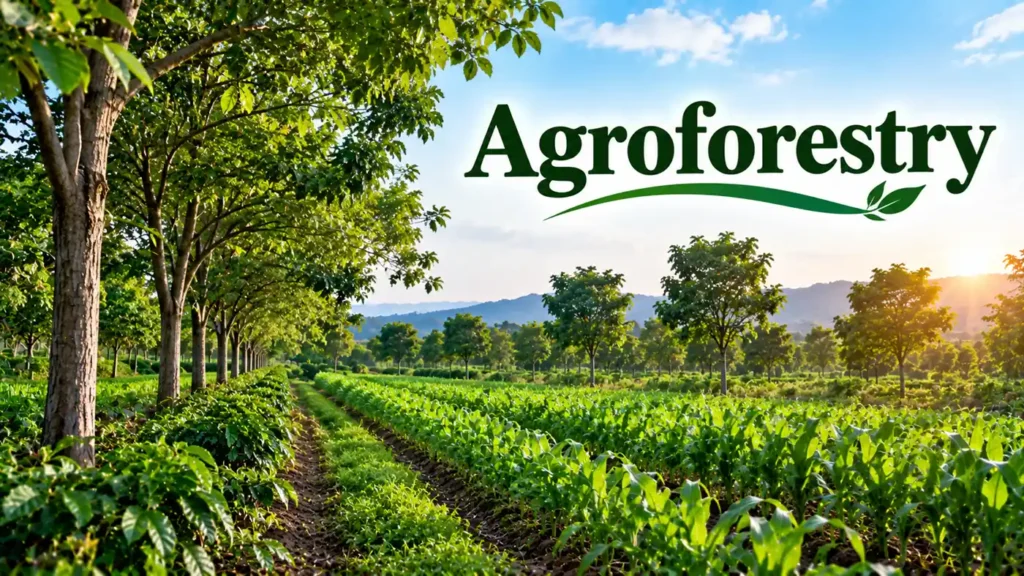
Agroforestry
Agriculture is encountering increasing difficulties due to climate change, soil degradation, water scarcity, and a decline in biodiversity. In response to the need to keep productivity high while at the same time protecting natural resources, agroforestry has become a significant sustainable method of farming.
Agroforestry involves growing trees and shrubs together with crops and/or livestock on the same piece of land; by combining different kinds of vegetation and agricultural practices, the system is able to bring economic advantages to farmers while at the same time improving soil health, biodiversity, and environmental resilience.
What is Agroforestry?
Agroforestry is a land-use system in which trees and woody plants are deliberately integrated with crops, livestock, or both. Unlike conventional agriculture, where trees may be removed to maximize cultivated area, agroforestry treats trees as an important part of the farming system.
Farmers might grow fruit trees together with their crops, plant trees around agricultural fields, combine trees with livestock that are kept for grazing, or set up systems intended for the production of timber, fuelwood, fodder, or other products.
The choice of trees and crops depends on factors such as climate, soil type, water availability, land size, and the farmer’s economic objectives.
Types of Agroforestry
Agroforestry can take several forms based on how trees, crops, and livestock are arranged.
Agrisilviculture
Agrisilviculture combines trees with agricultural crops. Farmers may grow crops such as cereals, pulses or vegetables between rows of trees. The trees can provide timber, fruit, fuelwood, fodder or other useful products.
Silvopasture
Silvopasture combines trees, pasture and livestock. Trees can provide shade and shelter for animals, while their leaves or fruits may sometimes provide additional sources of fodder.
Agrosilvopastoral Systems
These systems combine trees, crops and livestock on the same land. They allow farmers to obtain multiple products while making use of different layers of vegetation.
Home Gardens
Home gardens are another form of agroforestry, particularly common in tropical and subtropical regions. They may contain fruit trees, vegetables, herbs, spices, and other useful plants around homes.
Benefits of Agroforestry
One of the major advantages of agroforestry is its ability to provide multiple sources of income and agricultural products. Depending on the system, farmers can obtain fruits, timber, fodder, fuelwood, crops, and livestock products from the same land.
Trees also play a role in the conservation of soil since their roots can help keep the soil in place and reduce the erosion caused by wind and water; meanwhile, leaf litter contributes organic matter to the soil when it decomposes, and this in turn can help to maintain soil fertility.
Agroforestry can also improve water management. Tree roots can increase soil structure and water infiltration, while vegetation cover can reduce surface runoff.
Agroforestry and Climate Change
Trees play an important role in climate-change mitigation because they absorb and store carbon dioxide as they grow. Agroforestry systems can therefore contribute to carbon sequestration while maintaining agricultural production.
Trees can create more favorable microclimates by providing shade and lessening the impact of heat and wind; this is particularly valuable for livestock and certain crops in regions where temperatures are high and rising.
However, the climate benefits of agroforestry depend on the tree species, management practices, soil conditions and overall design of the farming system.
Agroforestry and Biodiversity
Agricultural landscapes dominated by a single crop can provide limited habitats for wildlife. Introducing trees, shrubs and other vegetation can create more diverse habitats for birds, insects, soil organisms and other species.
Certain agroforestry systems can also offer food and shelter for pollinators and helpful insects. Having greater biological diversity can help to maintain ecological balance and aid agricultural productivity.
Agroforestry in India
A practice of combining trees with farming and livestock systems has long been practiced in India, and farmers in various areas make use of trees for their fruit, as fodder, for fuelwood, for timber, to provide shade, and for soil conservation.
Examples are found in systems that include crops together with trees such as neem, bamboo, mango, guava, teak, and various nitrogen-fixing species, though the most appropriate combination will vary according to the local environmental and economic conditions.
Agroforestry can be particularly valuable for small and marginal farmers because it can provide several products and sources of income rather than relying entirely on a single annual crop.
Challenges of Agroforestry
Despite its benefits, agroforestry also presents certain challenges. Trees require time to mature, and farmers may have to wait several years before receiving returns from timber or fruit production.
Poorly designed systems can also create competition between trees and crops for sunlight, water, and nutrients. Choosing suitable species and maintaining appropriate spacing is therefore essential.
Farmers may also require technical knowledge about pruning, tree management, crop selection, and harvesting. Access to markets for tree-based products can be another important consideration.
The Future of Agroforestry
As agriculture moves towards more sustainable and climate-resilient practices, agroforestry offers an opportunity to combine food production with environmental conservation.
Better access to scientific knowledge, improved planting material, modern irrigation, digital agricultural services, and appropriate government support can help farmers adopt agroforestry more effectively.
By designing farming systems according to local ecological and economic conditions, agroforestry can become an important component of sustainable agriculture.
FAQs about Agroforestry
Agroforestry provides a practical way to integrate trees, crops and livestock while making agricultural landscapes more diverse and resilient. It can help improve soil health, reduce erosion, support biodiversity, diversify farm income and contribute to climate-change mitigation.
Because careful planning and long-term management are necessary for agroforestry to be successful, the fact that it can combine agricultural production with environmental benefits means that it is a promising method for the future of sustainable farming.

Home gardens serve the purpose of both home-decor aesthetics and sustainable agroforestry.