India has rapidly grown in organic farming practices due to its traditional and unique agricultural practices. With the growing population and rise in demand for food consumption, the food industry demands the production of organic and chemical-free food. Therefore, organic farming is becoming an absolute necessity for the agricultural revolution and the target to the achievement of the vision of an organic state in India. Certain regions among the states of India emerge as leaders in organic agriculture, sustainability, and food security.
The blog covers organic farming states in India, showcasing how each contributes to making the organic state in India a reality.
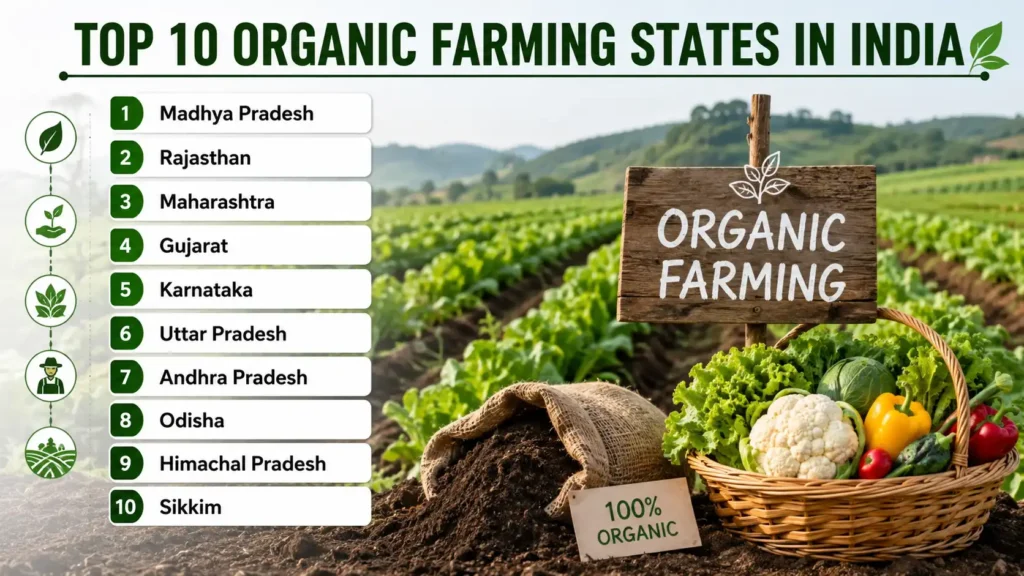
Top 10 Organic Farming States In India
Organic farming is modernizing agriculture by focusing on sustainable, chemical-free practices. While states like Madhya Pradesh and Maharashtra lead in total acreage and production share, several other regions have taken the lead in this green movement. Here are the top 10 organic farming regions championing sustainable growth.
Madhya Pradesh: A Developing Hub of Organic
Farming
Often celebrated as the “Granary of India” for its expansive conventional agriculture, Madhya Pradesh has emerged as a powerhouse, covering massive tracts of land under certified organic cultivation. Centered around districts like Jabalpur, Sehore, and Chhindwara, the state has significantly boosted output through dedicated farmer training and institutional support.
Rajasthan: Broadening The Scope Of Organic Farming
Despite its arid conditions, Rajasthan is heavily investing in organic farming to counter soil erosion and water depletion. Focused primarily on mustard, wheat, and pulses, the state government has launched specialized schemes for desert regions, successfully helping farmers adopt better soil and water management frameworks.
Maharashtra: A Region Beginning to Embrace
Organic Farming
As a titan in overall agricultural production, Maharashtra has steadily expanded its footprint in organic farming over recent years. Efforts are heavily concentrated on producing organic cotton and vegetables across Nashik and Pune. The state government actively facilitates progress through organic fairs, sustainable technique workshops, and certification guidance.
Gujarat: The New Era of Organic Farming
Historically identified with cash crops like cotton and groundnut, Gujarat has embraced a new era of sustainable agriculture. Farmers are increasingly shifting toward organic methods for cotton and vegetables, aided by private firms and cooperatives supplying organic inputs and verification services.
Karnataka: The Southern Star
Capitalizing on the Western Ghats, Karnataka is a major producer of specialty coffee, tea, and pepper that are in high global demand. Furthermore, the state is heavily pushing for organic millet production, perfectly capitalizing on the worldwide “superfood” trend.
Uttar Pradesh: The Organic Giant of the Gangetic Plains
As India’s most populous state, Uttar Pradesh‘s transition toward organic cultivation is vital for national food security. The state focuses on converting the fertile Gangetic plains into clean organic zones, promoting sustainable yields of organic sugarcane, mangoes, and aromatic Basmati rice.
Andhra Pradesh: Natural Farming Trailblazer
Andhra Pradesh deserves a special mention for its policy-driven approach. Driven by large-scale community-managed natural farming initiatives, hundreds of thousands of farmers are trained and supported in adopting low-cost, chemical-free regional practices.
Odisha: The Rising Tribal Organic Frontier
Odisha has steadily transformed its tribal belt into an organic frontier. By encouraging indigenous farming communities to formalize traditional zero-budget practices into certified organic production, the state has boosted local rural economies significantly.
Himachal Pradesh: A Pioneer in Organic Farming
Himachal Pradesh has made phenomenal contributions to the top 10 organic farming narrative. Famous for its apple orchards and productive horticulture, the state has actively expanded organic initiatives across districts like Kullu, Kangra, and Mandi. Backed by government assistance and favorable weather, Himachal continues to reduce chemical fertilizer dependency while boosting soil health.
Also read: Who are Agripreneurs and Why They are Important?
Sikkim: First Organic State of India
The first and ultimate model of an organic state in India. Below all reports, a small Himachal state in the North East of India. It is celebrated for being India’s first fully organic state. Sikkim became the first state to go fully organic in 2016, and after this, the whole of Sikkim has started to use organic farming methods in all agricultural lands of the region. The story of Sikkim is successful due to the favorable climate, the absence of industrial pollution, and government investment in the area. Sikkim’s commitment has not only changed the investment landscape of the state but also opened up new frontiers in tourism, as more and more people keen to know about organic farming visit the state.
Sikkim is the frontrunner in organic farming in India. With over 75,000 hectares of area under organic farming in India set aside for organic farming. As a state, Sikkim has proved that with the right focus, economies can grow while remaining environmentally friendly.