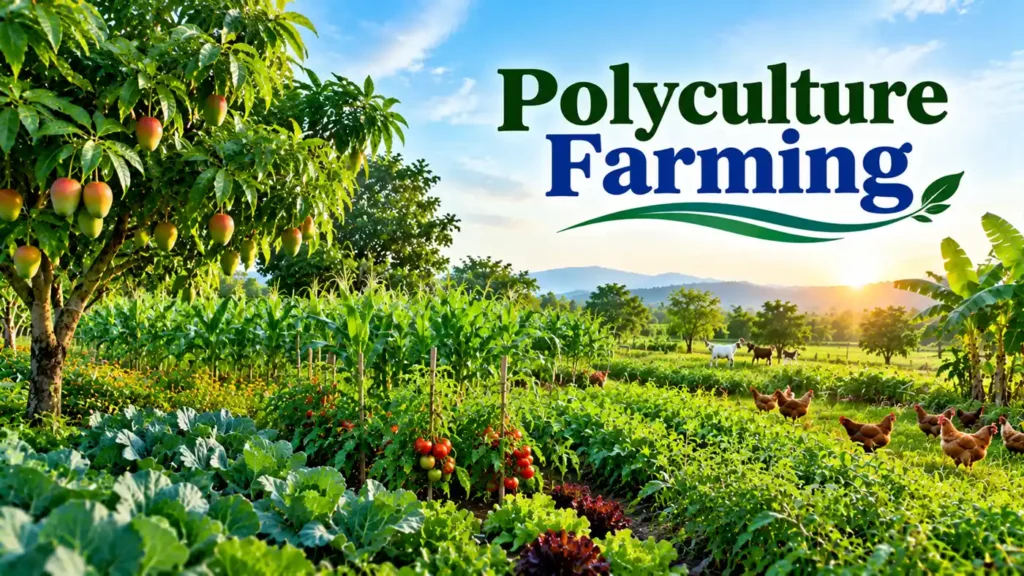
Polyculture farming is an agricultural practice in which two or more crop species are cultivated together on the same piece of land during the same growing season. Unlike monoculture farming, which involves growing a single crop over a large area, polyculture promotes crop diversity and makes use of different plant characteristics to improve agricultural productivity.
This form of farming is able to make use of the land and resources at hand in a more efficient way and at the same time help to maintain soil health and promote biodiversity; furthermore, by choosing the appropriate crops, polyculture can also lower the risks linked to crop failure, pest infestations, and fluctuations in environmental conditions. The practice occurs in a variety of ways all over the world and can be applied to small-scale farms, home gardens, and big agricultural systems.
Types of Polyculture Farming
Polyculture farming can be practiced through different methods depending on the crops, climate, and agricultural objectives.
Intercropping
Intercropping involves growing two or more crops simultaneously in the same field in a planned arrangement. For example, farmers may grow maize alongside beans. The crops can make use of different resources, while leguminous crops may contribute nitrogen to the soil through biological nitrogen fixation.
Mixed Cropping
Mixed cropping means growing two or more crops together in the same field without needing to place them in separate rows. It is possible for this method to reduce the risk of a total crop failure since different crops react in various ways to weather conditions and pests.
Relay Cropping
In relay cropping, a second crop is planted before the first crop has been harvested. This allows the growing periods of the two crops to overlap and can improve the use of available land and growing seasons.
Agroforestry
Agroforestry involves growing trees or shrubs together with agricultural crops and, in certain cases, also includes livestock. For instance, farmers can grow crops in the rows between fruit trees. This method can yield extra products, promote biodiversity, and assist in protecting the soil.
Integrated Crop Livestock Farming
This method involves combining the growing of crops with the rearing of livestock. The residues from crops can be used as feed for the animals, and when animal manure is properly managed, it can be reused in agricultural fields as a source of nutrients. It is an integrated form of farming that can include polyculture practices.
Benefits of Polyculture Farming
Polyculture farming offers several potential environmental and economic benefits.
Improved Biodiversity
Growing different crops together creates a more diverse agricultural environment. This can provide habitats and food sources for beneficial insects, pollinators, and other organisms.
Better Resource Utilisation
Different crops have different root depths, different needs in terms of nutrients, and different growth patterns. By choosing crops that are suitable with one another, farmers can make more efficient use of sunlight, water, and soil nutrients.
Reduced Pest and Disease Risks
Crop diversity can make it more difficult for certain crop-specific pests and diseases to spread rapidly across an entire field. However, the effectiveness of this approach depends on the crops and pests involved.
Improved Soil Health
Certain crop combinations can help maintain soil cover, reduce erosion, and support soil organisms. Including legumes may also improve nitrogen availability when appropriate crops and management practices are used.
Greater Income Diversification
Farmers growing multiple crops may have several products to sell rather than depending on the market price of a single crop. This can reduce financial risks associated with price fluctuations or the failure of one crop.
More Efficient Land Use
Polyculture allows farmers to combine crops with different growth habits and harvesting periods. When planned properly, this can increase the total productivity of a given area of land.
Challenges of Polyculture Farming
Despite its advantages, polyculture farming also presents certain challenges.
Complex Crop Management
Different crops may require different amounts of water, fertilizer, sunlight, and care. Managing these requirements simultaneously can be difficult.
Labour Requirements
The labor needed for planting, weeding, harvesting, and keeping an eye on several crops can be greater than that required for growing a single crop, especially since machinery is designed for monoculture systems.
Competition Between Crops
If crops are poorly selected or planted too closely together, they may compete for sunlight, water, nutrients, and growing space, reducing yields.
Difficulties With Mechanisation
Different crop heights, planting arrangements, and harvesting periods can make the use of standard agricultural machinery more challenging.
Market Limitations
Farmers may need to find separate buyers and storage facilities for several crops. Limited local demand or inadequate transportation can affect profitability.
Need for Technical Knowledge
Successful polyculture requires careful planning, including the selection of compatible crops, suitable planting arrangements, and appropriate harvesting schedules.
Polyculture Farming in India
Polyculture farming has considerable relevance in India, where diverse climatic conditions and traditional agricultural practices support the cultivation of multiple crops.
Farmers may grow cereals, pulses, vegetables, and oilseeds together or combine annual crops with fruit trees, depending on regional conditions. For example, maize and beans can be cultivated together, while certain farming systems combine coconut trees with banana, pineapple, or other compatible crops.
Polyculture is especially useful to small and marginal farmers who want to diversify their production and cut down on their reliance on a single crop; at the same time, growing a variety of crops can lead to greater diversity of food within the household and offer several sources of income over the course of the year.
Difference Between Polyculture and Monoculture Farming
Polyculture and monoculture differ primarily in the number and diversity of crops cultivated within a farming area.
In polyculture farming, multiple crop species are grown together, potentially improving biodiversity and spreading production risks. In monoculture farming, a single crop is cultivated in a given field during a growing season, allowing farmers to specialize in crop management and often making mechanization easier.
Although monoculture is suitable for large-scale commercial farming, it might lead to a reliance on one crop and make the farming system more susceptible to particular pests, diseases, and changes in the market.
Though polyculture may improve diversification, it could also require more meticulous planning and management. No singular method is typically superior; it depends on the farmer’s selection criteria.
The Future of Polyculture Farming
Polyculture farming could be of great importance in the development of more diverse and resilient agricultural systems; when farmers are encountering problems like climate change, soil degradation, water scarcity, and changing market conditions, growing a number of compatible crops offers the possibility of improving resource efficiency and distributing production risks.
Modern agricultural research is able to determine appropriate crop combinations, planting patterns, and harvesting schedules, and precision agriculture, together with improved seed varieties and better soil management practices, can further increase the productivity of polyculture systems.
Mixing traditional farming knowledge with scientific research can help farmers create practices that are suitable for the local environmental conditions. Polyculture can make a contribution to sustainable agriculture and to long-term rural development, provided that proper planning and market support are in place.
FAQs about Polyculture Farming
Polyculture farming is a method of farming which consists of growing two or more types of crops together in order to make better use of resources, promote biodiversity, and diversify agricultural production; its possible advantages are better soil protection, less reliance on a single crop, and greater flexibility when it comes to managing production risks.
Even though the method might call for extra work, technical knowledge, and careful choice of crops, it does provide valuable chances for farmers who are looking to adopt more diversified farming systems. If appropriate management is applied and the system is adapted to the particular region, polyculture can help to achieve agricultural sustainability and more resilient food production.