India is known for its diversity, colors, and especially for its variety of seasons. We experience different seasons in one year, each with its own festivals. June and July bring scorching heat, followed by a less hot, windier summer in August. As the rainy season approaches, fall feels like being a 2000s movie protagonist with a journal in hand. Then the rainy season arrives and brings showers that stay for a while. As Christmas approaches, winter brings snow to the hills and cold winds to the plains. Winter lasts slightly less than summer.
All of these seasons add a new vibe and color to the country and its people. While most countries experience mostly one season a year, India is blessed with seasonal diversity.
But like everything, the climate has its pros and cons.
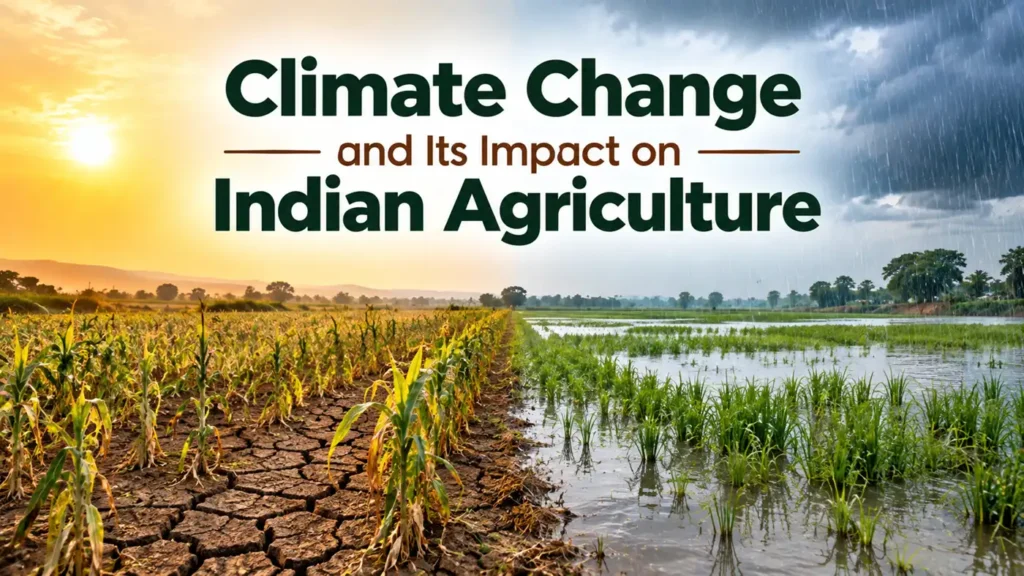
Climate change is now one of the greatest challenges facing agriculture all over the world, since India is especially at risk because of its reliance on monsoon rains, the variety of climatic conditions it has, and the fact that it has a large farming population. Increasing temperatures, alterations in rainfall patterns, heatwaves, droughts, floods, and other unpredictable weather events are having an impact on agricultural production.
For Indian farmers climate change represents more than merely an environmental issue since it has a direct effect on crop production, the condition of the soil, the amount of water available, livestock, farm incomes, and food security. It is important to understand these effects if a more resilient and sustainable agricultural sector is to be developed.
Now let’s take a deeper look to understand this phenomenon.
How Climate Change Affects Indian Agriculture
Rising Temperatures
Increasing temperatures can affect the growth and productivity of several crops. Crops such as wheat are particularly sensitive to heat during important stages for development. Higher temperatures can shorten crop growing periods and reduce yields. Heat stress can also impact livestock by reducing feed intake, milk production, fertility, and overall animal health.
Changing Rainfall Patterns
Indian agriculture relies heavily on the monsoon. Changes in the timing, intensity, and distribution of rainfall can create difficulties for farmers.
Too little rainfall can result in drought and crop failure, while excessive rainfall over a short period can cause waterlogging, soil erosion, and flooding. Even when total seasonal rainfall remains adequate, an uneven distribution can negatively affect agricultural operations.
Frequent Extreme Weather Events
Since climate change occurs, the risk linked to extreme weather events like heatwaves, floods, droughts, and heavy rainfall increases. Such events are capable of damaging existing crops, the agricultural infrastructure, stored food and livestock. Small and marginal farmers might be particularly vulnerable since they generally have less financial resources available to recover from sudden losses.
Water Scarcity
Freshwater is mainly used in India for agricultural purposes, and as temperatures rise evaporation and the amount of water needed for crops will increase, whereas the irregularity of rainfall will make it harder to plan irrigation.
The falling levels of groundwater in certain agricultural areas add another degree of pressure, so that water-efficient methods of irrigation, the collection of rainwater, and better water management can therefore become all the more important.
Soil Degradation
Heavy rainfall can speed up soil erosion, and long-lasting drought together with high temperatures can lead to a decrease in soil moisture. Alterations in soil conditions have an impact on the availability of nutrients and on crop productivity. Methods such as crop rotation, mulching, conservation agriculture, the management of organic matter, and agroforestry can all help to improve soil resilience.
Impact on Major Indian Crops
Climate change can affect crops differently depending on the region, variety, and soil water.
- Wheat: higher temperatures during the grain-filling stage can reduce productivity.
- Rice: alterations in rainfall and temperature can influence the amount of available water, the growth of the crops, and the yields.
- The pulses: may see their flowering, pod development, and total yield affected by drought and heat stress.
- The flowering of fruits and vegetables as well as their fruit development, quality and marketability can be affected by temperature fluctuations and irregular rainfall.
- The growth and yield of oilseeds can be affected by heat and moisture stress.
Economic Impact on Farmers
The effects of climate change go well beyond crop production; reduced yields can lead to lower farm incomes, and at the same time extreme weather events can cause an increase in spending on irrigation, seeds, pesticides, the care of livestock, and the recovery of crops.
Price fluctuations may further complicate the situation when climate-related production losses affect the supply of agricultural commodities.
For farmers, improving climate resilience is therefore closely connected with protecting livelihoods and maintaining stable agricultural incomes.
Climate Resilient Agriculture in India
India has been promoting several approaches to make agriculture more resilient to changing climatic conditions. These include climate-resilient crop varieties, efficient irrigation, weather-based advisories, crop diversification, soil health management, agroforestry and improved risk management mechanisms.
Farmers can furthermore decrease the risks associated with climate change by growing a variety of crops, taking up drought- or heat-tolerant types where appropriate, using irrigation systems that conserve water, keeping soil covered and making their decisions on the basis of weather information.
Digital agriculture and improved access to timely weather and market information can further help farmers plan sowing, irrigation, harvesting, and other farm activities.
Government Initiatives
The Indian government has introduced various programs and schemes that support agricultural sustainability, irrigation efficiency, crop insurance, soil health, and climate resilience. The National Mission for Sustainable Agriculture (NMSA), Pradhan Mantri Krishi Sinchayee Yojana (PMKSY), Pradhan Mantri Fasal Bima Yojana (PMFBY), and the Soil Health Card Scheme are among the initiatives relevant to these areas.
Research institutions and agricultural universities are also working on developing and promoting technologies and crop varieties better suited to changing climatic conditions.
FAQs about Climate Change’s Effect on Indian Agriculture
Climate change presents a complex challenge for Indian agriculture, affecting everything from crop productivity and water availability to farmer incomes and food security. However, its impact can be reduced through a combination of climate-resilient technologies, sustainable farming practices, efficient resource management, scientific research, reliable weather information, and effective policy support.
It is not merely a matter of dealing with extreme weather after the fact to build climate-resilient agriculture; it is about preparing both farmers and agricultural systems so that they can adapt to changing conditions while at the same time protecting natural resources. A resilient agricultural sector will be essential for ensuring India’s food supply, the livelihoods of people in rural areas, and the long-term sustainability of agriculture.