In agriculture, pests and diseases present major problems since they can damage crops, lower productivity, affect the quality of food, and result in heavy financial losses for farmers. In the past, chemical pesticides and fungicides have been extensively used in order to deal with these issues. Yet, the overuse or incorrect use of chemical treatments can be detrimental to beneficial organisms, lead to soil and water contamination, and cause pesticide resistance to develop.
Sustainable ways to manage pests and diseases offer environmentally appropriate ways to protect crops without sacrificing agricultural productivity. Such methods involve the use of preventive farming practices, biological control, the employment of crop varieties that are resistant to diseases, careful monitoring, and the reasonable use of pesticides when necessary. By adopting these practices, farmers can protect their crops, conserve biodiversity, and secure the long-term health of agricultural ecosystems.
What is Sustainable Pest and Disease Management?
Sustainable pest and disease management refers to the use of environmentally responsible and economically practical methods to prevent, monitor, and control crop pests and diseases while minimizing harmful effects on human health and the environment.
This approach aims to control pest populations and plant diseases rather than eliminate all organisms that cause them, because some organisms play important roles in agricultural ecosystems and excessive chemical use can disrupt the ecological balance of the soil and ecosystem.
An essential part of sustainable management is Integrated Pest Management (IPM), which involves using a combination of biological, cultural, mechanical, and chemical methods based on the particular requirements of a crop and the degree of pest or disease risk.
Common Causes of Crop Pests and Diseases
It is important to understand the various factors that lead to pest infestations and plant diseases if effective management strategies are to be developed.
1. Unfavourable Weather Conditions
High humidity, too much rain, extreme temperatures, and the prolonged wetness of the leaves can provide favorable conditions for some plant pathogens. Also, weather conditions can affect the reproduction, dispersal, and survival of insect pests.
2. Monocropping
By repeatedly growing the same crop over large areas, it is possible to supply a continuous source of food for specialized pests and pathogens. As a result, their numbers may increase, and some diseases may be able to remain in the soil or in the crop residues.
3. Poor Soil Health
Unbalanced nutrients in the soil, bad drainage, and poor soil structure can lead to weaker plant growth and make plants more susceptible to certain diseases. Good soil fosters beneficial microorganisms which play a role in nutrient cycling and can help to suppress some soil-borne pathogens.
4. Infected Seeds and Planting Material
Seeds, seedlings, and plants that are grown vegetatively may carry pests or organisms that cause disease from one place to another, and the use of infected planting material can lead to troubles appearing in fields that would otherwise be healthy.
5. Improper Agricultural Practices
Applying too much fertilizer, failing to carry out adequate field sanitation, using irrigation that is not suitable, and incorrectly using pesticides can all lead to problems with crop health. Such practices may also disrupt the beneficial organisms and raise the chance of pest outbreaks.
Importance of Sustainable Pest and Disease Management
Sustainable management practices provide several benefits for farmers, consumers, and the environment.
1. Reducing Dependence on Chemical Pesticides
Preventive measures, the use of biological control methods, and routine monitoring can lead to a reduction in the need for pesticide applications, after which chemical treatments can be kept for cases in which they are appropriate and applied in accordance with the recommended guidelines.
2. Protecting Beneficial Organisms
Ladybirds, lacewings, parasitic wasps, spiders, and other beneficial organisms contribute to the control of pests in agriculture, and pollinators also have an important role in the production of crops. Sustainable management aims at protecting these organisms by avoiding any interventions that are unnecessary or harmful.
3. Maintaining Soil Health
Good soil fosters beneficial microorganisms and helps to ensure strong plant growth. It is possible to improve soil conditions and decrease the persistence of some soil-borne pests and diseases by rotating crops, managing organic matter, and using suitable cultivation practices.
4. Preventing Pesticide Resistance
Repeated use of pesticides with the same mode of action can encourage resistant pest populations to develop. Integrating different management methods and following recommended resistance-management practices can help preserve the effectiveness of available treatments.
5. Improving Farmers’ Economic Stability
Preventing crop damage can protect yields and improve the quality of agricultural produce. Moreover, cutting down on unnecessary chemical applications may reduce input costs, though the financial advantages will vary depending on the crop, the local conditions, the labor requirements, and the management methods employed.
Methods of Sustainable Pest and Disease Management
There are a number of methods that, when used together, can enable farmers to control pests and diseases without disrupting the environment.
1. Integrated Pest Management
Integrated Pest Management is a systematic method that brings together various pest-control techniques so that pest numbers remain below the level at which unacceptable economic damage occurs.
Its main components include:
- Monitoring involves regularly checking the crops to spot any pests, diseases, and early warning signs.
- For prevention, one should use crop rotation, plant resistant varieties, employ healthy planting material, and carry out proper field management.
- Biological control involves encouraging or introducing natural enemies that are suitable for pests.
- For mechanical control, you can remove the damaged plant parts, use traps, or set up physical barriers whenever this is feasible.
- Chemical control carried out in a targeted manner involves the use of approved pesticides when the monitoring shows that action is needed.
- By using IPM, farmers are given a systematic method of crop protection, and at the same time the unnecessary use of pesticides is reduced.
2. Biological Control
Biological control involves using living organisms or their natural products to manage agricultural pests and diseases.
Examples include:
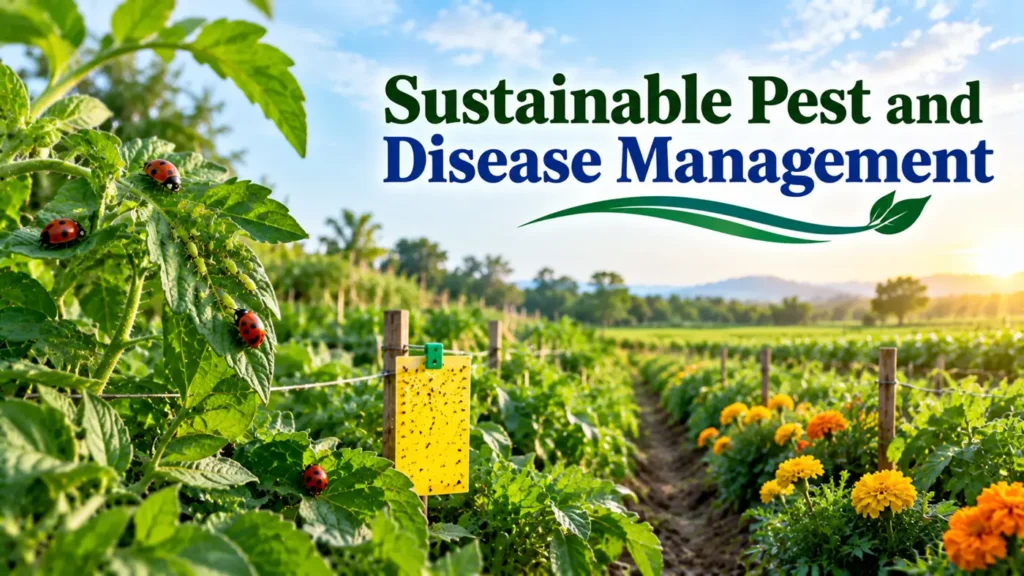
- LADYBIRDS: Feed on aphids and certain other small insect pests.
- TRICHOGRAMMA WASPS: Parasitize the eggs of certain crop-damaging moths.
- PREDATORY MITES: Help control some harmful mite populations.
- TRICHODERMA SPECIES: Certain strains can suppress specific soil-borne plant pathogens.
- BACILLUS THURINGIENSIS: Certain formulations control susceptible insect larvae.
Biological control agents must be selected according to the target pest or pathogen, crop, and local conditions. Their effectiveness depends on factors such as temperature, humidity, application timing, and compatibility with other treatments.
3. Crop Rotation
Crop rotation involves growing different crops in sequence on the same field rather than repeatedly cultivating the same crop.
Rotating crops with unrelated plant families can interrupt the life cycles of certain pests and pathogens. For example, rotating a susceptible cereal crop with a suitable legume may help manage some crop-specific problems and improve soil fertility.
However, crop rotation must be planned carefully because some pests and pathogens can survive on multiple host plants.
4. Resistant Crop Varieties
Planting varieties with resistance or tolerance to specific pests and diseases is an effective preventive strategy.
It is possible to reduce crop damage, lower the need for certain pesticide applications, and improve yield stability by growing resistant varieties. Farmers should consider the climatic conditions of the area, the kind of soil, and the pests and diseases that are common in their region when choosing varieties.
Resistance should also be managed responsibly because some pest populations and pathogens can evolve over time.
5. Cultural Practices
Cultural control involves modifying agricultural practices to make conditions less favorable for pests and diseases.
These measures are capable of helping to prevent outbreaks and of improving the general health of crops.
6. Mechanical and Physical Control
Mechanical and physical methods directly remove, exclude, or disrupt pests.
Examples include using insect nets, installing suitable traps, manually removing heavily infested plant parts, and using barriers to prevent pests from reaching crops.
Solarisation, which involves covering appropriately prepared moist soil with transparent plastic during periods of strong sunlight, can help suppress certain soil-borne pests, weeds, and pathogens under suitable conditions.
Such methods are particularly advantageous on small farms, in greenhouses, and when cultivating high-value crops, although in the end the question depends on the amount of labor available, the costs concerned, and the local environmental conditions.
7. Botanical Pesticides
Botanical pesticides are derived from plants and can be used to manage certain agricultural pests.
Neem-based products containing azadirachtin, for example, can help control specific insect pests by affecting feeding, growth, or development.
Plant-derived products are not necessarily safe, since they can have an effect on beneficial insects and other organisms that are not the target of the product, and their effectiveness may differ. Farmers should use products that are properly registered and follow the instructions on the label, as well as avoid using untried mixtures.
8. Responsible Chemical Pesticide Use
Chemical pesticides might still be necessary if pest populations pose a threat of serious crop damage and no other methods are adequate.
Sustainable use requires that the correct pest be identified, an appropriate product that is approved be chosen, the recommended application rate be followed, suitable protective equipment be used, and the pre-harvest intervals and all other label requirements be observed.
It is helpful to rotate the use of pesticides with different modes of action when this is appropriate, and farmers should also avoid spraying under conditions that increase drift or contamination, taking care to protect pollinators, water sources, and other beneficial organisms.
Role of Technology in Sustainable Pest and Disease Management
Modern technologies are improving the detection and management of agricultural pests and diseases.
Remote Sensing
Satellite imagery and drone-based monitoring can help identify crop stress and locate areas that require further inspection.
Artificial Intelligence
Image-recognition tools can assist in identifying certain plant diseases and pests from photographs, although their accuracy depends on image quality, the crop, and the conditions in which the tool was developed.
Smart Sensors
Field sensors can monitor temperature, humidity, soil moisture, and other conditions associated with crop health and disease risk.
Digital Advisory Platforms
Mobile applications and agricultural advisory services can provide information about pest outbreaks, weather conditions, preventive practices, and recommended treatments.
Precision Spraying
Suitable precision-application systems can target affected areas and help reduce unnecessary pesticide use.
These technologies are most effective when combined with field observations and expert guidance rather than used as a replacement for accurate diagnosis.
Sustainable Pest and Disease Management in India
Agriculture in India faces diverse pest and disease challenges because of differences in climate, cropping patterns, soil conditions, and farming systems. Farmers may encounter problems such as fall armyworm in maize, aphids in several crops, fungal diseases in cereals and vegetables, and soil-borne diseases in susceptible crops.
Sustainable management can help address these challenges through locally appropriate approaches.
Key measures include:
- PROMOTING IPM: Agricultural extension services can help farmers combine preventive, biological, mechanical, and chemical control methods.
- USING HEALTHY PLANTING MATERIAL: Certified or otherwise appropriately verified seeds and disease-free planting materials can reduce the introduction of certain pests and pathogens.
- ENCOURAGING CROP DIVERSIFICATION: Suitable crop rotations and intercropping systems can disrupt some pest life cycles and improve farm resilience.
- SUPPORTING EARLY DETECTION: Weather-based advisories, field monitoring, and digital agricultural services can help farmers respond to emerging threats before they become widespread.
Government-supported integrated pest management programs and agricultural research initiatives can contribute to these efforts. However, management recommendations should be adapted to the specific crop, pest or pathogen, and local growing conditions.
Challenges in Sustainable Pest and Disease Management
Although sustainable methods offer significant benefits, their adoption can face several difficulties.
Limited Awareness
Some farmers may have insufficient access to information about biological control, pest monitoring, and integrated management.
Initial Costs
Some tools, traps, resistant seeds, monitoring systems, and special biological products may require an initial outlay of money.
Variable Effectiveness
The effect of biological and cultural methods may vary according to the weather, the pressure from pests, the type of crop, and the local conditions.
Availability of Quality Products
Farmers may find it difficult to obtain reliable biological control agents or suitable registered products in some regions.
Need for Regular Monitoring
IPM requires timely field inspections, accurate pest identification, and informed decision-making.
Resistance Development
Poorly planned use of pesticides and other control measures can reduce their long-term effectiveness.
Addressing these challenges requires accessible training, reliable agricultural advisory services, affordable technologies, and stronger connections between farmers and research institutions.
The Future of Sustainable Pest and Disease Management
The future of sustainable pest and disease management lies in moving away from reactive crop protection and towards prevention, early detection, and informed intervention.
Farmers ought to be encouraged to keep a regular watch on their crops, look after their soil so that it remains in good condition, use varieties that are resistant where these are available, conserve the beneficial organisms, and combine a number of different methods of management. Agricultural organizations and policy-makers can help to achieve this change by improving access to training, supporting research, and enhancing the availability of reliable crop-protection products.
It is possible to maintain crop productivity while at the same time reducing environmental risks and helping to ensure the long-term sustainability of agriculture.
FAQs about Sustainable Pest and Disease Management
Sustainable pest and disease management is essential for protecting crops, maintaining agricultural productivity, and preserving environmental health. By combining Integrated Pest Management, biological control, crop rotation, resistant varieties, cultural practices, and responsible pesticide use, farmers can manage crop threats more effectively.
In India, it is possible to make sustainable crop protection more accessible by increasing farmers’ awareness, improving access to suitable technologies, and strengthening agricultural extension services. Sustainable pest and disease management, as a result of ongoing research and coordinated action, can help to create more resilient farming systems, improve livelihoods, and achieve long-term food security.